Inflatable mirror balls can be used outdoors, but “all weather” performance depends on material, UV package, seam construction, pressure management, and anchoring. With the right spec and care, they’ll handle light rain and typical temperature swings; without it, gloss loss, seam stress, and leaks show up fast. If you also need tailored outdoor specs or finishes, see customize inflatable mirror balls.
Table of Contents
- Will they withstand rain or extreme temperatures?
- How should I protect them from the elements?
- Do outdoor models require additional features?
- How can I maintain them in harsh conditions?
- Conclusion
- References
Will they withstand rain or extreme temperatures?
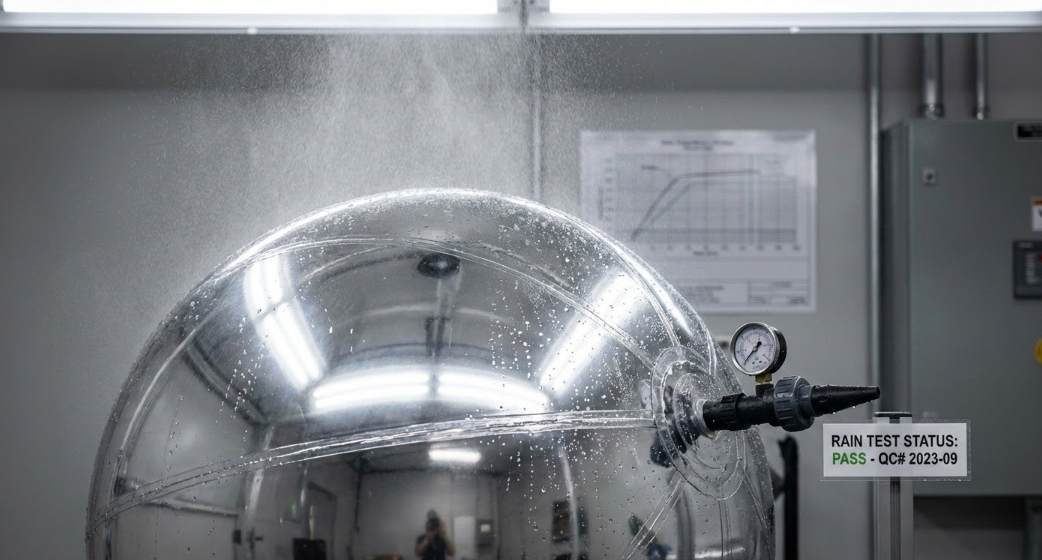
- Rain: PVC/TPU films are inherently water-resistant; properly RF/heat‑welded seams and capped valves will handle light to moderate rain. The metallized “mirror” layer should be protected by a clear coat to limit haze and spotting. Avoid high‑pressure jets and solvent cleaners.
- Heat: Internal pressure rises as temperature increases; over‑inflation in the morning can become excessive at noon, stressing seams and valves. Expect the supplier to provide an operating range (e.g., 0–40°C for standard PVC, wider for TPU).
- Cold: Standard PVC stiffens in cold and may crease‑whiten; TPU maintains flexibility better at low temperatures. For freezing conditions, request an outdoor TPU or flexible PVC grade and avoid folding when below the minimum service temperature[3][4].
- Sun/UV: Prolonged UV exposure drives gloss loss, yellowing, and embrittlement unless the film includes UV stabilizers and HALS, validated by accelerated weathering such as ASTM D4329 or ISO 4892‑2[1][2].
- Wind: The balls are sails; wind loads concentrate at D‑rings and seams. Define a max operating wind speed, and plan to deflate/store above that threshold.
Best practice: ask for a one‑page weathering summary (method, exposure hours, results) and seam strength data before you commit[1][2][7].
How should I protect them from the elements?
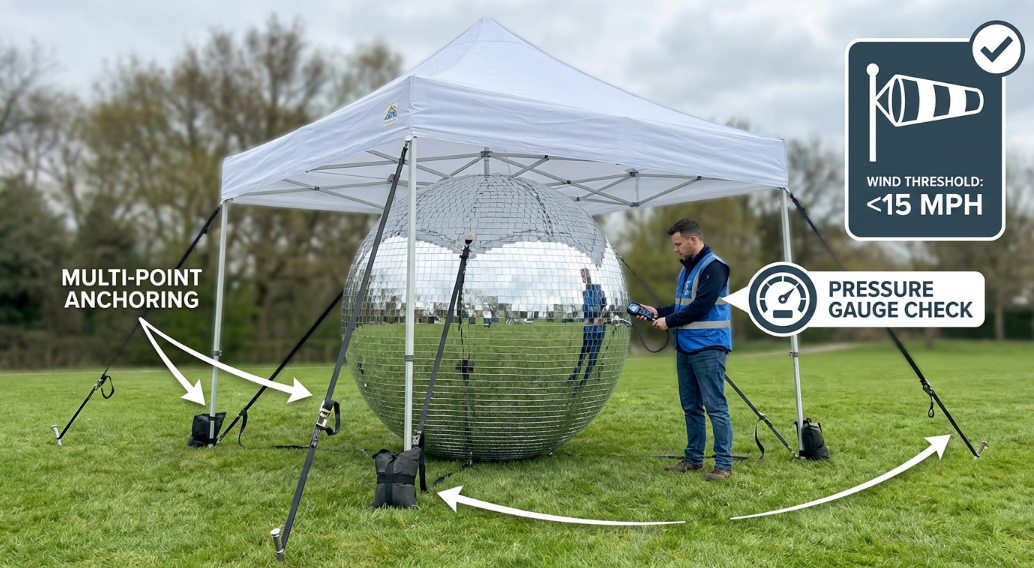
- Shade and placement: Use canopies or shade sails for long daytime exposures; avoid installing next to abrasive surfaces or sharp edges.
- Pressure management: Inflate to the lower end of the spec in the morning; re‑check mid‑day. Never “rock hard” in cool air that will heat up.
- Anchoring: Use multiple stainless D‑rings with load distribution; never rely on a single point. Follow a conservative wind limit and a clear deflate/store protocol.
- Rain protocol: Wipe dry after rain; don’t let dirty water dry on the surface. Avoid jet washing and harsh chemicals.
- Storage between uses: Rinse (coastal sites), dry fully, and store in a cool, shaded, ventilated place. Use soft interleaves to prevent print‑through or sticking.
If the installation is multi‑day, add a daily inspection: pressure, seams, hardware, surface cleanliness.
Do outdoor models require additional features?
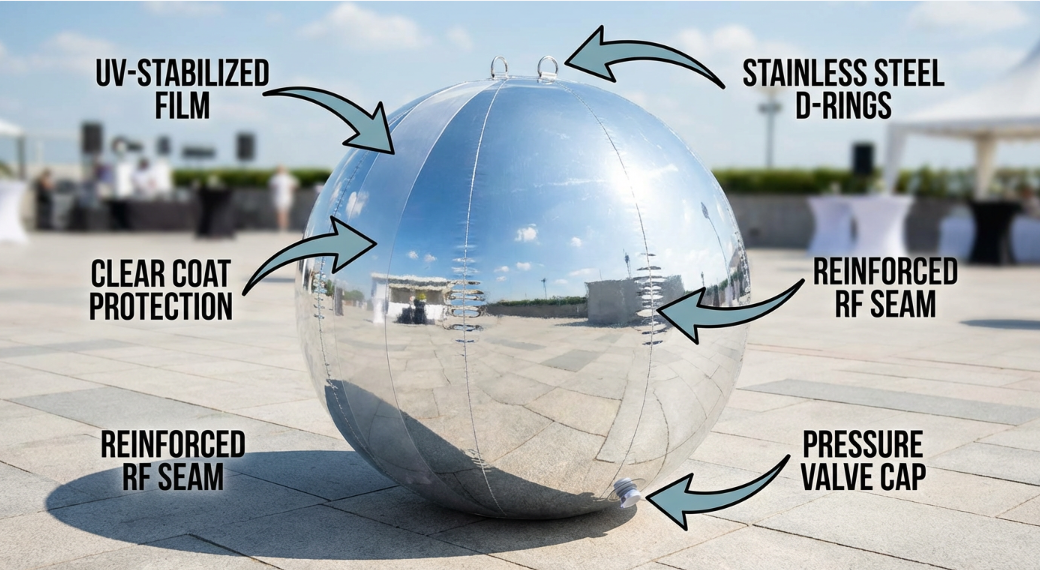
Request an “outdoor-rated” spec with these upgrades:
- UV-stabilized film: PVC or TPU with documented UV package (ASTM D4329/ISO 4892 data)[1][2][3][4].
- Protective clear coat: Over the metallized layer to preserve gloss and reduce micro‑scratch visibility.
- Thicker gauge: +0.1–0.2 mm vs. indoor models for better puncture and creep resistance.
- RF/heat‑welded seams with reinforcement: Ask for seam strength/peel data (ASTM D751)[5][7].
- Hardware: 304/316 stainless D‑rings/loops and reinforced patches sized for expected wind loads.
- Valve and caps: Quality inflation valve with sealing cap to reduce dust/water ingress.
- Documentation: QC photos/video, weathering summary, and a usage note with temperature and wind guidance.
- Custom options: Sizes/colors/graphics and mounting layouts—coordinate early so materials and topcoats align with your design; see customize inflatable mirror balls.
How can I maintain them in harsh conditions?
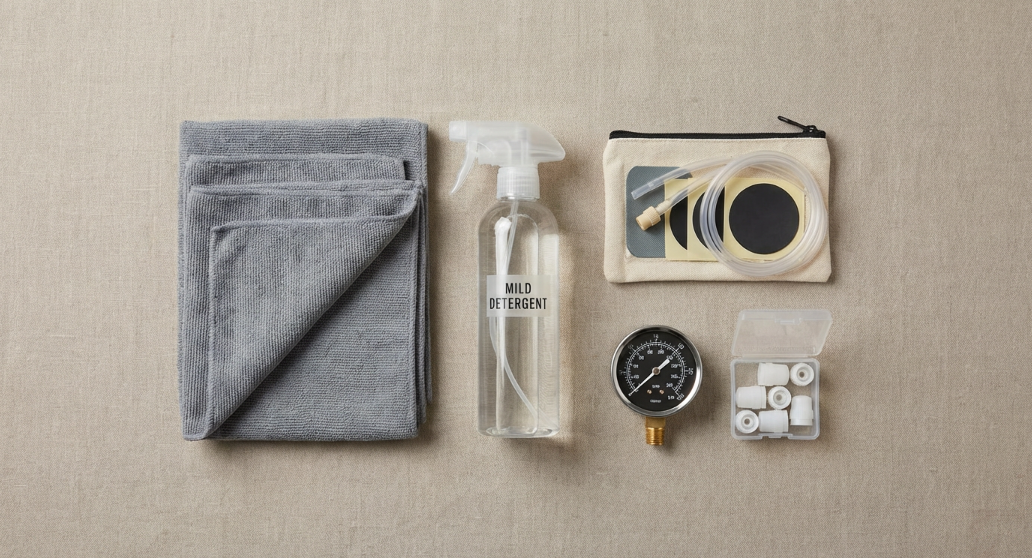
- Daily checks (multi‑day events): Pressure, seam/hardware inspection, wipe dust and water spots.
- Cleaning: Use mild soap and microfiber; avoid solvents, abrasives, and alcohols that can haze the clear coat.
- Leak checks: If pressure drops unexpectedly, spot‑test seams/valve with a mild soap‑bubble method; for systematic checks, adapt bubble emission concepts from ASTM F2096[8].
- Patching: Keep a matching patch kit and follow the supplier’s RF/adhesive instructions; patch in clean, warm, dry conditions.
- After harsh exposure: Rinse off salt/sand, dry thoroughly, and store loose (avoid tight creases). Don’t fold when film is cold and stiff.
- Replacement planning: For long outdoor campaigns, budget for rotation or replacement based on the supplier’s weathering data (exposure hours vs. gloss retention).
Conclusion
Inflatable mirror balls are outdoor‑capable when the spec matches the environment: UV‑stabilized film with a protective clear coat, reinforced RF seams and stainless hardware, smart pressure management, and a clear wind/rain protocol. Lock those in up front and verify with standard weathering and seam data to keep gloss high and downtime low. Need an outdoor‑specific spec or custom finish? Coordinate via customize inflatable mirror balls before production.
References
[1] ASTM D4329 — Fluorescent UV Exposure of Plastics
https://www.astm.org/d4329
[2] ISO 4892-2 — Plastics — Xenon-arc exposure methods
https://www.iso.org/standard/77365.html
[3] Lubrizol — Estane TPU Weatherability Resources
https://www.lubrizol.com/Engineered-Polymers
[4] Teknor Apex — Weatherable Vinyl (PVC) Compounds
https://www.teknorapex.com/vinyl
[5] Miller Weldmaster — RF/Heat Sealing of PVC/TPU
https://www.millerweldmaster.com/blog/rf-heat-sealing
[6] BASF — Tinuvin UV Absorbers and HALS for Plastics
https://plastics-rubber.basf.com/global/en/performance_additives/brands/tinuvin.html
[7] ASTM D751 — Coated Fabrics Test Methods (including seam strength)
https://www.astm.org/d0751
[8] ASTM F2096 — Detecting Gross Leaks by Bubble Emission (concept for leak checks)
https://www.astm.org/f2096


![What Is an Air Track in Gymnastics? [Complete Guide]](http://ueeshop.ly200-cdn.com/u_file/UPBF/UPBF509/2605/13/photo/WhatIsanAirTrackinGymnastics.png)


