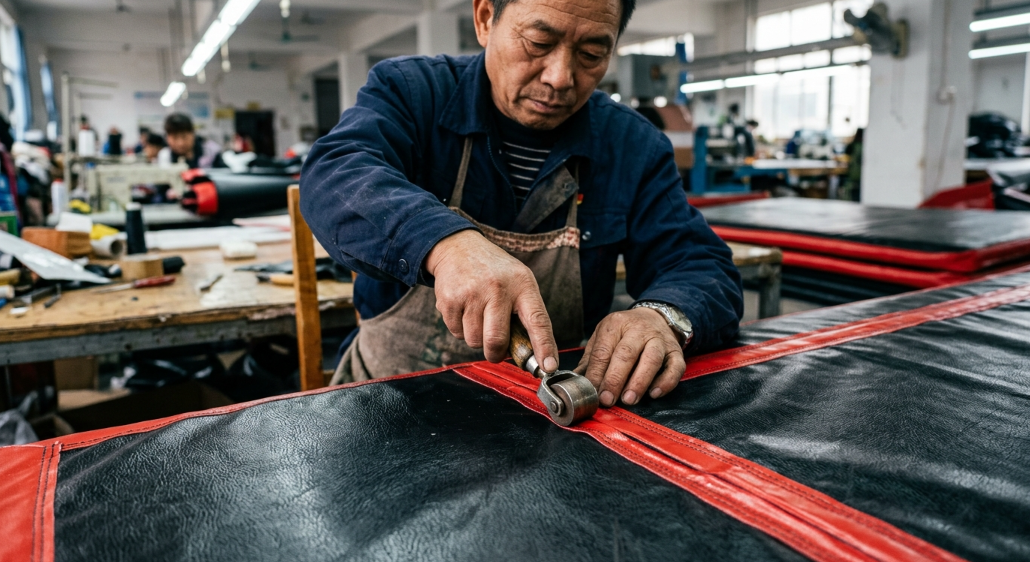
How much does a supplier's manufacturing experience matter for inflatable wrestling mats? Manufacturing experience is paramount because inflatable mats rely on manual precision in "High-Frequency Welding" and "Hand-Gluing" seams. A supplier with at least 5–8 years of experience will have mastered the tension requirements of "Drop-stitch" fabric and the chemical bonding of PVC, which prevents delamination and air leaks. Inexperienced factories often struggle with "pressure retention," leading to products that lose air within hours—a critical failure for professional B2B buyers like gyms and martial arts schools.
Table of Contents
- How Many Years of Experience Should I Look for in a Supplier?
- Can a Newer Factory Still Deliver Reliable Quality?
- What Problems Happen with Inexperienced Manufacturers?
- How Can I Evaluate Real Experience Beyond Claims?
- Interactive Quiz: The Experience Check
- Conclusion
How Many Years of Experience Should I Look for in a Supplier?
In the inflatable industry, the "Sweet Spot" is typically 5 to 10 years.
Why? Because the first 3 years of any inflatable factory are usually spent "learning the hard way." Inflatable technology, specifically for inflatable wrestling mats, requires a deep understanding of material fatigue. A factory that has survived 8 years has likely refined its supply chain for glue (which has a shelf life) and PVC (which varies by batch).
The "Experience Pyramid" for Sourcing
| Years in Business |
Risk Level |
Capability |
| 1-2 Years |
High |
Learning the basics; prone to high defect rates. |
| 3-5 Years |
Medium |
Stable production; may lack advanced customization. |
| 5-10 Years |
Low (Ideal) |
Mastered seam technology; strong QC systems. |
| 10+ Years |
Very Low |
Often higher prices, but "set and forget" reliability. |
Can a Newer Factory Still Deliver Reliable Quality?
The short answer: Yes, but only if they "stole" the talent. Often in China's manufacturing hubs like Huadu, a technical manager from a top-tier factory will leave to start their own shop. In this case, the company is new, but the expertise is old.
However, as a B2B buyer, this is a gamble. A new factory lacks "Institutional Memory." They might have a great head engineer, but do they have a trained workforce of 50 people who know exactly how much heat to apply to a seam? Probably not. For a bulk order of Air Tracks, you are better off with a factory that has a "Low Staff Turnover" rate.
Expert Insight: If you're considering a "young" factory, check their SOPs (Standard Operating Procedures). A professional setup will have documented steps for every weld, regardless of how long they've been in business.
What Problems Happen with Inexperienced Manufacturers?
Inexperience in the inflatable world doesn't just look "ugly"—it's dangerous. For B2B buyers supplying gyms or Amazon customers, a faulty mat is a liability nightmare.
- Delamination (The "Bubble" Effect): If the internal "Drop-stitch" fibers aren't anchored correctly or the heat-sealing is uneven, the mat will develop a massive bulge.
- Slow Leaks: Inexperienced workers often rush the valve installation. The mat might look fine for 2 hours but be soft by the next morning.
- Chemical Off-gassing: New factories often buy cheaper, "recycled" PVC to lower costs. This results in a heavy toxic smell that will lead to customer returns in the US and EU.
- Poor Pressure Tolerance: Professional wrestling requires high PSI. An inexperienced factory might use glue that "creeps" or softens when the mat is left in the sun or under high pressure.
How Can I Evaluate Real Experience Beyond What Suppliers Claim?
Everyone on Alibaba says they have "20 years of experience." Here is how you cut through the noise:
- Check Export Records (Customs Data): Use tools like ImportGenius or Panjiva. If they claim to be a 10-year-old expert but have no shipping records to major US/EU brands from 5 years ago, they are likely lying.
- The "Technical Deep-Dive" Question: Ask them: "What is the specific tensile strength of your 1000D drop-stitch fabric, and what is your glue's heat-resistance rating?" A trading company or a new factory will give a vague answer. An expert will send you a spec sheet instantly.
- Verify the "Established Date" on the Business License: This is public record. If their license was issued in 2024, they aren't a "10-year veteran" company.
- Look at the Factory's Own Tooling: An experienced factory often has custom-made jigs and molds for their inflatable wrestling mats rather than generic equipment.
Interactive Quiz: The Experience Check
You are reviewing a supplier. Which of these is the MOST reliable sign of manufacturing experience?
- A. A "Gold Supplier" badge on Alibaba for 10 years.
- B. High-resolution photos of a clean showroom.
- C. A history of CE/EN14960 certifications dating back several years in the same company name.
- D. They respond to your emails in less than 5 minutes.
Answer: C is the winner! Certifications are time-stamped and verified by third parties like TUV or SGS. Response speed (D) only proves they have a good salesperson, not a good factory.
Conclusion
When you buy an inflatable wrestling mat for your B2B business, you aren't just looking for a vendor; you're looking for a partner who has already survived their "learning curve." Stick to factories with a proven 5+ year track record and verifiable export data. It might cost 5% more upfront, but it will save you 50% in potential returns and headaches.
References
- CPSC (U.S. Consumer Product Safety Commission): Safety Guidelines for Inflatable Play Equipment [^1]
- SGS Group: Quality Control Standards for PVC Inflatables [^2]
- Made-in-China.com: Understanding Supplier Business Licenses and Audit Reports [^3]


