A professional QC process is divided into three critical stages: IQC (Incoming Quality Control) for raw DWF/PVC materials, IPQC (In-Process Quality Control) focused on seam welding and internal thread alignment, and OQC (Outgoing Quality Control) featuring the mandatory 48-hour pressure test. To audit this remotely, you must demand a digital "QC Pass" trail—including photo evidence of raw material batch numbers and live video of the final inspection.
What specific quality control steps will my mats go through?
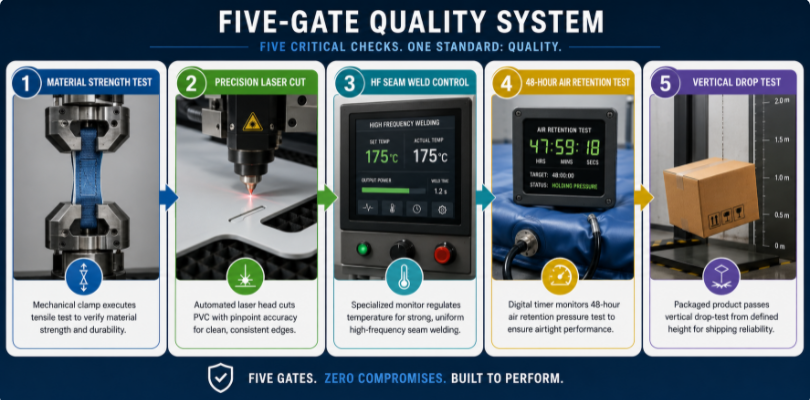
A top-tier factory follows a Five-Gate System:
- Material Tensile Test: Ensuring the DWF (Double Wall Fabric) can withstand pressures up to $10\text{--}15 \text{ PSI}$ without bursting.
- Laser Cutting Accuracy: Automated cutting to ensure seams align perfectly (misaligned seams are the #1 cause of future leaks).
- High-Frequency (HF) Welding Monitor: Checking that the temperature and pressure during the welding of the side rails are consistent.
- 48-Hour Air Retention: (As covered previously) The final pressure stability test.
- Accessories & Packaging Check: Verifying pump voltage (US vs. EU), repair kit contents, and carton drop-test ($1.5\text{m}$ height).
How do I audit a Chinese factory's internal QC system remotely?
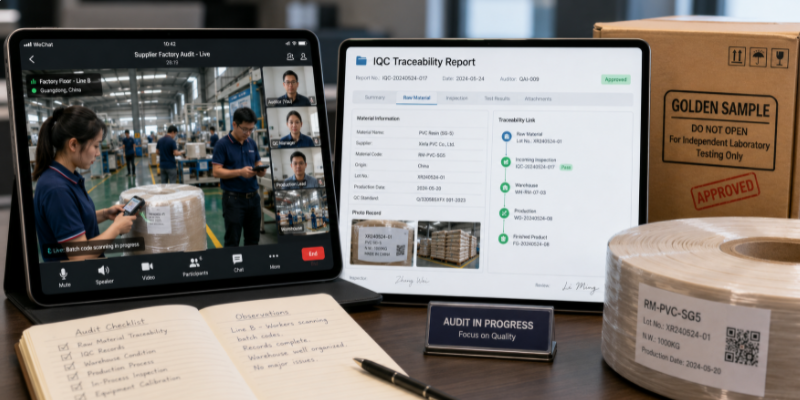
You don't need a plane ticket to audit a factory. Use these "Digital Audit" tactics:
- Live "Walk-Through" on WeChat/Zoom: Ask for a surprise video call. Have them show you the testing area. If you see mats deflated on the floor or a messy environment, their QC is likely lax.
- The "Batch Traceability" Test: Pick a random finished unit and ask them to show you the IQC Report for the specific roll of PVC used to make that exact mat. If they can’t find it, they have no real traceability.
- Reference Samples: Have the factory ship a "Golden Sample" to a third-party lab (like Intertek) for independent UV and tensile testing before mass production begins.
Will I have a dedicated QC manager overseeing my production run?
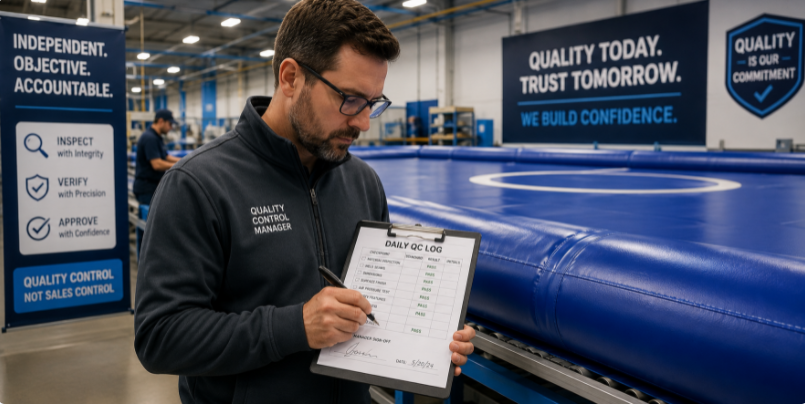
In a standard "Alibaba" order, the answer is often no—the salesperson acts as the middleman. For a high-volume B2B order, you must negotiate for a Lead QC Lead:
- The Difference: A dedicated QC manager reports to the factory owner, not the sales team. Their job is to find faults, while the salesperson’s job is to ship quickly.
- Your Request: "I require a signed Daily QC Log from your internal Quality Manager, Mr./Ms. [Name], for the duration of my production run." This creates personal accountability.
What raw material inspections should I require?
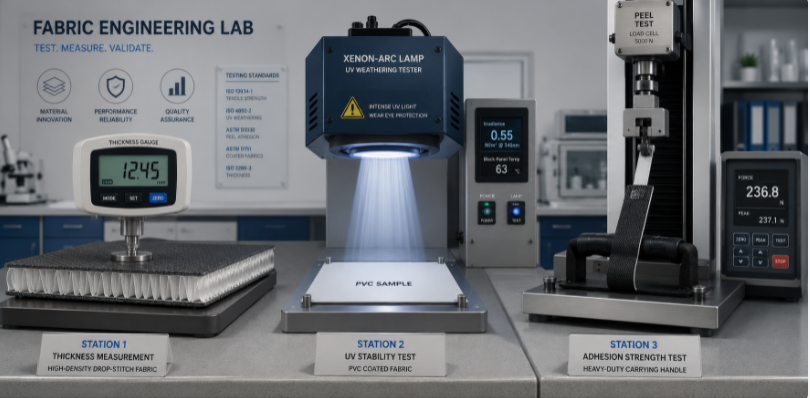
The quality of an inflatable mat is 70% determined by the raw material batch. Require these three tests before the first cut is made:
- Denier & Weight Verification: Confirming the DWF is at least $1,000\text{ Denier}andthePVCweightis\ge 0.9\text{mm}(approx.$2700g/m2).
- UV Stability Rating: Ask for a Xenon-arc test report (ISO 4892-2) to ensure the mat won't yellow or crack under the sun.
- Adhesion Strength Test: For glued components (like handles), a peel test is vital to ensure the glue doesn't fail at high temperatures.
Interactive QC Strategy Quiz
1. What is the biggest risk of skipping the "Laser Cutting" accuracy check?
- A) The mat will be the wrong color.
- B) Misaligned seams create "stress points" that will lead to catastrophic air leaks 6 months later.
- C) The mat will be too heavy.
- (Answer: B - Precision at the cutting stage ensures a uniform weld.)
2. If you are auditing a factory remotely and they refuse a "surprise" video call, what does this usually indicate?
- A) They are busy making your mats.
- B) They might be outsourcing your order to a smaller, lower-quality workshop.
- C) Their Wi-Fi is broken.
- (Answer: B - "Sub-contracting" is common in China when a factory is over-capacity; a live call verifies they are actually making your goods.)
3. What is the purpose of an "IQC" report?
- A) To check the final packaging.
- B) To verify the quality of raw materials (PVC, DWF, Glue) before production starts.
- C) To calculate the shipping cost.
- (Answer: B - Incoming Quality Control is the first line of defense.)
Conclusion
Remote importing doesn't have to be a gamble. By implementing a strict Five-Gate QC system, demanding batch traceability, and holding a specific QC manager accountable, you turn the factory from a "black box" into a transparent production partner. Remember: The price you pay for QC is always lower than the price you pay for a recall.
References & Footnotes
- ISO 2859-1:1999: Sampling procedures for inspection by attributes — Part 1: Sampling schemes indexed by acceptance quality limit (AQL) for lot-by-lot inspection. (The global standard used by third-party agencies like QIMA/V-Trust for determining sample sizes and reject thresholds during Pre-Shipment Inspections). ISO Standard Link
- ISO 9001:2015: Quality management systems — Requirements. (The foundational benchmark for evaluating a Chinese factory’s internal quality control system and material traceability). Explore ISO 9001
- ASTM D751-19: Standard Test Methods for Coated Fabrics. (The designated standard for verifying tensile strength, tear resistance, and adhesion strength of PVC and Double Wall Fabric layers). ASTM International Link
- ISO 4892-2:2013: Plastics — Methods of exposure to laboratory light sources — Part 2: Xenon-arc lamps. (The scientific baseline used to verify the UV stability and anti-yellowing performance of wrestling mat surfaces). Technical Data


