A professional QC process is not a single check, but a continuum. It begins with IQC (Incoming Quality Control) to verify raw DWF fabric, moves to IPQC (In-Process) to monitor high-frequency welding, and culminates in OQC (Outgoing) with a mandatory 48-hour pressure test. To succeed remotely, you must replace "trust" with "verifiable digital evidence" at every gate.
What specific quality control steps will my mats go through during production?
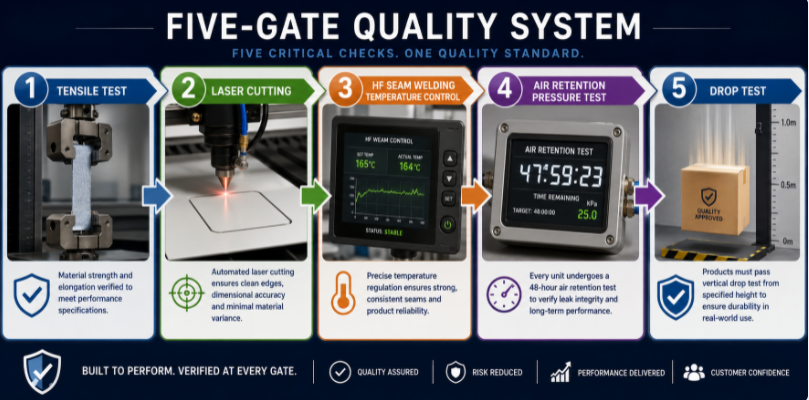
A top-tier manufacturing run follows the "Five-Gate System":
- Gate 1: Precision Laser Cutting: Unlike manual cutting, laser CNC ensures the PVC panels match the design dimensions within ±1mm. Misalignment here is the root cause of "twisting" in finished mats.
- Gate 2: High-Frequency (HF) Welding Monitoring: The side rails are fused using HF waves. QC must monitor the dwell time and pressure settings to ensure the seam doesn't "starve" (too cold) or "burn" (too hot).
- Gate 3: Internal Drop-Stitch Alignment: Before sealing, the internal polyester threads are inspected for uniform density. If the threads are tangled, the mat will bulge when inflated to high PSI.
- Gate 4: 48-Hour Pressure Stabilization: The final "stress test" where mats are kept at 1.2x their working pressure to detect micro-leaks.
- Gate 5: Cosmetic & Accessory Audit: Checking for glue stains, print clarity, and ensuring the air pump plug matches your target market’s voltage (e.g., 110V for the US).
How do I audit a Chinese factory's internal QC system remotely?
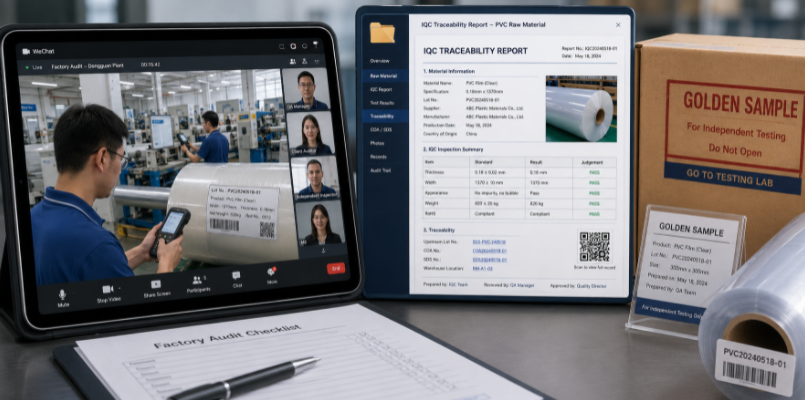
You don't need to be in China to "see" the truth. Use these Remote Audit Hacks:
- The "Surprise" WeChat Video Walkthrough: Ask your rep for a 5-minute live tour of the current testing floor. If they claim the "lights are off" or "workers are at lunch" during normal hours, it’s a red flag.
- Request the "Red Tag" Log: Every real factory has a "Red Tag" area for defective units. Ask to see the log of failed units from last month. If a factory claims they have 0% defects, they are lying about their QC.
- Digital Traceability Audit: Pick a finished mat from a photo they sent you. Ask them to show you the Material Certification for the specific roll of PVC used for that unit. If they can’t link the finished product to the raw material, their system is weak.
Will I have a dedicated QC manager overseeing my production run?
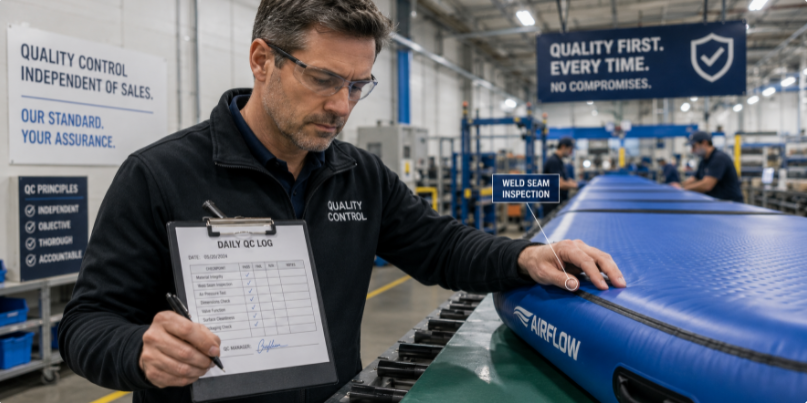
In the B2B world, "Sales" and "QC" should be separate. * The Reality: At small trading companies, your salesperson is the QC. This is a conflict of interest—they want to ship fast to get their commission.
- The Solution: For orders over 50 units, insist on a Dedicated QC Lead who is independent of the sales team.
- The Verification: Ask for the name and ID of the internal QC Lead. Demand that the final inspection report be signed by this individual, not the salesperson. This creates personal accountability within the factory hierarchy.
What raw material inspections should I require before manufacturing starts?
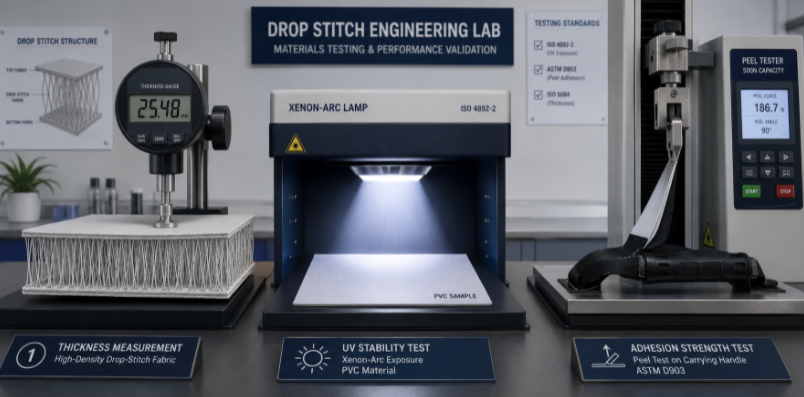
The "DNA" of your mat is determined before the first cut. Require these IQC (Incoming Quality Control) reports:
| Material Component |
Required Test |
Specification Benchmark |
| DWF (Drop-Stitch) |
Tensile Strength |
≥2500 N/5cm (Warp/Weft) |
| PVC Coating |
UV Resistance |
Grade 4-5 (ISO 105-B02) to prevent yellowing |
| Adhesive/Glue |
Peel Strength |
≥100 N/5cm to prevent handle detachment |
| Valves |
Airtightness |
Zero leakage at $10\text{ PSI}$ immersion test |
Interactive QC Strategy Quiz
1. You are auditing a factory remotely and notice the "Testing Room" is outdoors under a tent. Is this acceptable?
- A) Yes, it saves space.
- B) No, temperature fluctuations and wind make accurate pressure testing impossible.
- C) Yes, as long as it isn't raining.
- (Answer: B - Pressure testing must happen in a temperature-controlled indoor environment for accuracy.)
2. Why should you ask for a "Defect Log" during a remote audit?
- A) To see what colors they are making.
- B) To prove the factory actually has a filtering process for bad units.
- C) To get a discount.
- (Answer: B - A factory without a record of mistakes is a factory that ships its mistakes to the customer.)
3. What is the most important document to verify before mass production begins?
- A) The factory's business license.
- B) The IQC (Incoming Quality Control) report for the raw material batch.
- C) The salesperson's LinkedIn profile.
- (Answer: B - If the raw DWF material is weak, no amount of good labor can save the product.)
References & External Links
- ISO 2859-1: Sampling procedures for inspection by attributes. (The standard for AQL levels). Link to ISO
- ASTM D751: Standard Test Methods for Coated Fabrics. (Essential for PVC mat testing). Link to ASTM
- QIMA (External Resource): How to perform a factory audit in China. Visit QIMA


