WELCOME TO OUR BLOG

We're sharing knowledge in the areas which fascinate us the most
click

When importing inflatable wrestling mats from China, do you perform pressure retention tests?

By Gracie May 25th, 2026 120 views
Catalog

Yes, a formal pressure retention test is a non-negotiable step in professional quality control. Independent of visual leak checks, every commercial wrestling mat must be held under high pressure to verify its structural integrity. Importers should mandate a 48-hour testing window, allowing zero room for suppliers to cut corners on slower, hidden micro-leaks.

Why do I need to insist on a 48-hour pressure retention test?

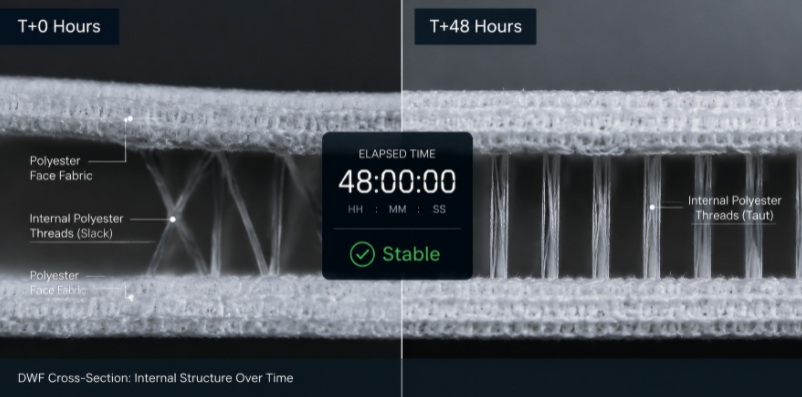
Technical diagram illustrating Double Wall Fabric (DWF) material stabilization and thread creep during a 48-hour pressure test for wrestling mats
Many factory sales reps will try to convince you that a 12-hour or 24-hour test is plenty. Do not back down on the 48-hour rule. Here is why from a materials science perspective:
  • The "Material Stretch" Buffer: When an inflatable mat woven with Double Wall Fabric (DWF) is first inflated, the PVC and thousands of internal polyester threads experience an initial mechanical stretch (material creep). This expansion naturally causes a minor volume change in the first 12 to 18 hours, masking micro-leaks.
  • Catching "Slow Creep" Failures: Micro-leaks caused by faulty valve threads or imperfect high-frequency seam welds do not show up immediately. It takes roughly 24 to 36 hours of continuous, sustained stress for these tiny escape routes to register a noticeable drop on a pressure gauge.
 

What is the acceptable PSI drop for my mats during factory testing?

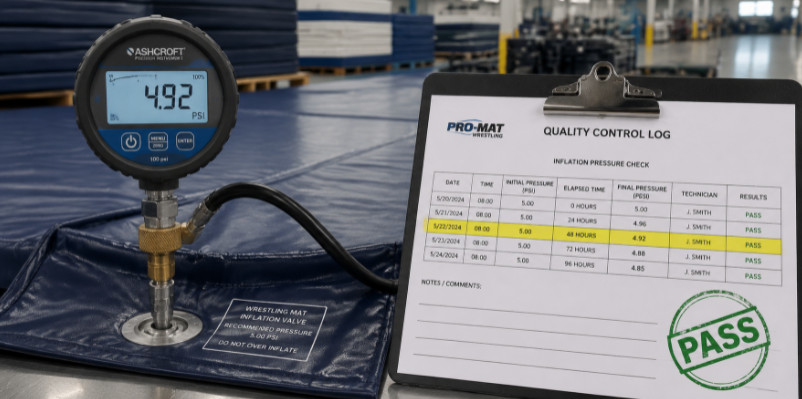
Factory QC station showcasing digital manometer reading and a pass log sheet for 48-hour mat pressure retention metrics
No inflatable fabric structure is 100% molecularly airtight over infinite time; minor gas permeation occurs naturally. However, there is a strict boundary between acceptable physics and a manufacturing defect.

Testing Duration Initial Pressure (PSI) Maximum Acceptable Drop Status
First 24 Hours 5.0 PSI \le 0.15 \text{ PSI} (approx. 3%) Pass (Attributed to DWF material stretching)
48-Hour Mark 5.0 PSI \le 0.25 \text{ PSI} (approx. 5%) Pass (Fully stabilized structural limit)
Any Window 5.0 PSI > 0.40 \text{ PSI}  FAIL (Indicates a valve seal issue or seam defect)

⚠️ Technical Note: This table assumes a constant ambient room temperature in the factory quality control bay. A drastic shift in factory temperature will alter these baselines.

How do I verify the pressure retention data provided by the supplier?

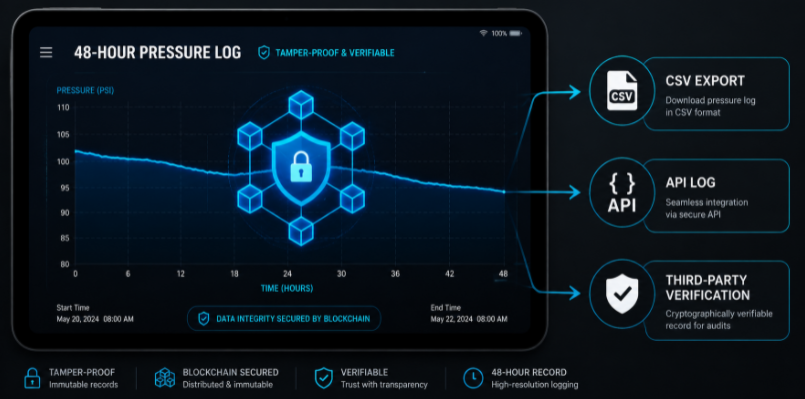
Infographic illustrating blockchain-verified digital data logging for pressure retention testing in B2B manufacturing
Distrust and verify. When dealing with overseas manufacturing, you cannot rely purely on a handwritten spreadsheet. Use these three verification strategies:
  • Bluetooth Data Loggers: Request that the factory uses a digital manometer with a Bluetooth logging function (such as an Elitech or Testo gauge). They can export an unalterable CSV or PDF graph showing the pressure curve over the full 48 hours.
  • The "Live Video Calibration" Walkthrough: During your pre-shipment video call, pick a few random mats from the testing floor. Have the worker show the unique serial number on the mat, and then immediately place a digital pressure gauge on the valve live on camera to cross-check against their logs.
  • Third-Party Inspection (PSI): Hire an agency (like SGS or V-Trust). Instruct the inspector to arrive at the factory, witness the inflation/sealing of sample mats, place a secure tamper-evident sticker over the valves, and return exactly 48 hours later to break the seal and read the final gauge.
 

Will my mats lose pressure differently when shipped to a colder US climate?

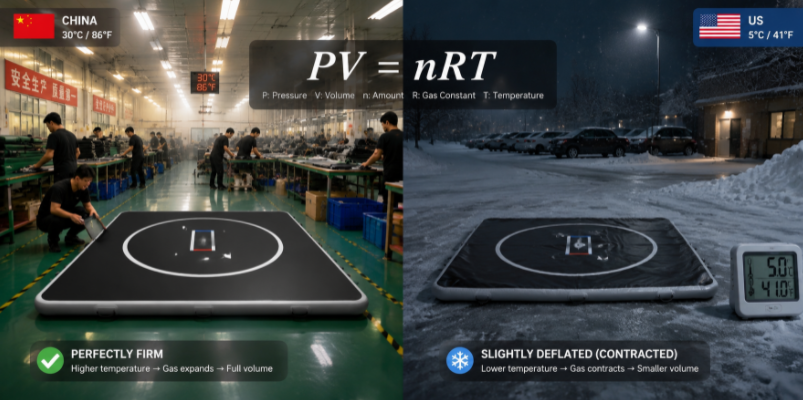
Visual comparison showing the physical impact of temperature change (thermal air contraction) on an inflatable mat shipped from China to a cold US climate
Yes, and this is the number one cause of false quality complaints from US gym owners.

If your mats are manufactured and tested in a humid, tropical manufacturing hub in Southern China (e.g., Guangdong at 30°C / 86°F) and then unboxed by your client in a cold winter climate in Ohio or New York (e.g., an unheated gym at 5°C / 41°F), the laws of physics take over.

According to Gay-Lussac's Law of ideal gases, pressure is directly proportional to absolute temperature (measured in Kelvin):P  2	​ =P  1	​ ⋅(  T  1	​ T  2	​ ​ )

When the air inside the mat cools down in the US, the molecules slow down and exert less force against the interior walls. The mat will feel soft and saggy, making it look like it leaked during transit. It did not leak; the air simply contracted. * The Solution: Educate your B2B clients to let the mats acclimate to room temperature indoor environments before judging their inflation status, and top off the air with the pump once it reaches the target environment's stable temperature.


Interactive Pressure Retention Quiz

1. What is the primary phenomenon that a 48-hour pressure test accounts for, which might mask a slow leak in the first day?

  • A) Valve seal seating.
  • B) Internal moisture evaporation.
  • C) Material Creep (Initial stretching of the DWF fabric).
  • (Answer: C - DWF requires 24-36 hours to fully stabilize, during which its expansion can hide minor air loss.)

2. According to the professional QC benchmark, what is the maximum acceptable pressure drop (PSI) for a professional wrestling mat (initially inflated to 5.0 PSI) after a full 48-hour stabilization period?

  • A) $0.05 \text{ PSI}$.
  • B) $0.25 \text{ PSI}$ (approx. 5%).
  • C) $1.0 \text{ PSI}$ (approx. 20%).
  • (Answer: B - This minor drop is due to natural gas permeation through the PVC molecular structure, which is acceptable.)

3. Why might a customer in Ohio complain that their new mat, which passed the 48-hour inspection in a 30°C factory, feels soft and "leaky" when opened in a 5°C gym?

  • A) The mat leaked during trans-Pacific shipping.
  • B) Gay-Lussac's Law: The colder temperature caused the air molecules inside to contract, decreasing the internal pressure.
  • C) The material cracked in the cold.
  • (Answer: B - Thermal contraction is a natural physical effect, not a product defect, and the customer should be educated to let the mat acclimate before use.)


Conclusion

Pressure retention testing bridges the gap between a generic inflatable toy and commercial-grade athletic equipment. By forcing a 48-hour testing protocol, establishing clear acceptable PSI metrics, using unalterable digital tracking, and preparing for thermal climate adjustments, you secure a reliable supply chain that keeps your brand's reputation rock solid.


References

  • ISO 6185-3: Inflatable boats — Part 3: Boats with a maximum motor power rating of 15 kW and forward speed capabilities. (Establishes international testing baselines for airtight chambers under prolonged stress). Explore ISO
  • ASTM F2049-11: Standard Guide for Fences/Barriers for Inflatable Play Devices. (Contextual data on air pressure safety margins). View ASTM
  • Journal of Vinyl and Additive Technology: Thermal Expansion and Gas Permeability Coefficients of Plasticized Polyvinyl Chloride. Technical Data
Are Air Tracks Worth It? [Complete Buying Guide],Aftersea
Previous
Are Air Tracks Worth It? [Complete Buying Guide]
Read More
When importing inflatable wrestling mats from China, what is your QC process?,Aftersea
Next
When importing inflatable wrestling mats from China, what is your QC process?
Read More

CONTACT US

If you have any queries, get in touch today! Don't hesitate. We try to take the extra step for our customer satisfaction.
CONTACT US
Name*
Email*
Message*
CAPTCHA*
Verification Code
We use Cookie to improve your online experience. By continuing browsing this website, we assume you agree our use of Cookie.