Customizable tumble air track mats offer B2B buyers greater branding potential, durability, and training versatility. By tailoring size, color, logo, thickness, and materials, gyms and sports distributors can increase product appeal, enhance athlete safety, and strengthen long-term ROI.
Introduction: Why B2B Buyers Value Customizable Tumble Track Mats
1. Branding Power: Custom Logos and Color Options on Tumble Air Track Mats
2. Perfect Fit: Custom Sizes and Shapes for Every Training Environment
3. Enhanced Durability: Material and Thickness Customization for Heavy Use
4. Functionality Upgrades: Add-On Features that Extend Mat Versatility
5. ODM Design Solutions: Tailored Innovations for Large-Scale Buyers
Making the Smart Move: How to Get Started with Custom Air Track Mats
Conclusion: Custom Tumble Air Track Mats as a Long-Term B2B Investment
In today’s competitive fitness and training industry, a standard product isn’t enough to stand out. As a B2B buyer, you’re not just purchasing equipment — you’re investing in brand identity, customer satisfaction, and operational efficiency. That’s where customizable tumble track mats and tumble air track mats deliver exceptional value.
Unlike mass-produced mats, customized versions allow you to specify details such as logo placement, brand colors, material thickness, and even shape. This means your gym, training center, or retail line doesn’t just use air tracks — it showcases your brand in motion.
Customization has become more than a design choice; it’s now a strategic decision. For example, a gymnastics training academy can order mats with reinforced layers for durability, while a cheerleading gym might choose lighter materials for fast setups and frequent moves. Each choice directly impacts training performance, safety, and lifespan.
Moreover, bulk customization lets you maintain visual consistency across branches or distributors — something that strongly appeals to clients and end-users seeking professionalism. As an added advantage, modern suppliers offer full ODM/OEM support, enabling B2B buyers to design exclusive models that elevate their brand’s market positioning.
If you’re looking to take your procurement strategy to the next level, start exploring how to customize air tracks to meet your business objectives. Tailored tumble track mats don’t just improve athlete experience — they strengthen your brand equity and long-term ROI.
When it comes to B2B purchases, branding is far more than a visual choice — it’s a strategic differentiator. Customizing tumble air track mats with your company’s logo and color palette helps create a unified brand identity that customers and athletes immediately recognize. Whether you’re supplying gyms, schools, or sports retailers, consistency in appearance builds trust and enhances the perceived professionalism of your equipment line.
Many leading manufacturers now offer advanced ODM printing technologies, allowing precise color matching and durable logo applications that resist wear, friction, and cleaning chemicals. These branding options are particularly beneficial for gym franchises or distributors aiming to establish brand continuity across multiple facilities.
Custom-colored tumble track mats can also be used to signify training zones or differentiate intensity levels, making them functional as well as visually appealing. For instance, a blue mat could mark safe landing zones in gymnastics, while a red one might indicate high-difficulty training areas.
Ultimately, personalized branding does more than decorate your mats — it strengthens your visibility in a crowded market, attracts client loyalty, and transforms each product into a mobile advertisement for your business.
If you want to explore visual branding that perfectly fits your market segment, you can start by requesting a design through customize air tracks.
Every professional training facility has its own space limitations, flooring layout, and training goals — and that’s where the ability to customize tumble track mats becomes a game changer. Instead of forcing one-size-fits-all equipment into diverse spaces, B2B buyers can now specify custom sizes and shapes to optimize every inch of the training area.
For example, gymnastics centers often require long linear mats for tumbling routines, while parkour gyms and martial arts studios may prefer square or modular mats that can be reconfigured. Cheerleading teams, on the other hand, might choose extra-wide tumble air track mats for synchronized practice sessions. By aligning mat dimensions with specific use cases, trainers can create safer, more efficient, and more engaging training environments.
Custom sizing also helps maximize ROI for facilities with limited floor space. Instead of purchasing multiple smaller mats that require constant rearranging, a single tailor-made mat can deliver the ideal coverage and performance for daily training. This reduces setup time and equipment wear, contributing to longer product lifespan and better cost efficiency over time.
From an operational standpoint, B2B buyers benefit from improved inventory control — fewer mismatched mats and more standardized, brand-aligned equipment that’s easy to market and maintain. Whether for indoor studios or outdoor athletic setups, the ability to define exact specifications ensures your investment fits your clients’ needs perfectly.
To explore the process of requesting custom dimensions and modular layouts, visit customize air tracks and discover how flexible design options can transform your training facility or product lineup.
For B2B buyers, longevity and reliability are non-negotiable. Whether you’re supplying gyms, training schools, or athletic retailers, your clients expect tumble air track mats that can withstand daily, high-impact use without losing performance. This is where material and thickness customization becomes an essential part of the investment.
High-quality tumble track mats are typically made with double-wall fabric and reinforced PVC layers using drop-stitch technology. However, not every facility needs the same build. For example, professional gymnastics centers often require thicker mats (20–30 cm) for safe landings, while fitness studios might prefer thinner mats (10–15 cm) for balance or yoga-style exercises. Choosing the right thickness ensures optimal energy absorption, stability, and user safety.
Buyers can also specify upgraded material compositions — such as UV-resistant coatings for outdoor use or enhanced air-tight valves for frequent inflation and deflation cycles. These technical upgrades significantly reduce maintenance costs and extend the product’s operational life, two factors that directly improve total cost of ownership (TCO) for commercial buyers.
Moreover, durable customization translates into brand reputation. A gym or distributor known for providing resilient, professional-grade mats naturally earns customer trust and repeat business. It’s not just about the mat’s structure; it’s about delivering a consistently safe and reliable user experience.
To design mats that align with your usage intensity and technical demands, you can start a consultation through customize air tracks. Tailoring your mats’ durability features today ensures years of dependable performance tomorrow.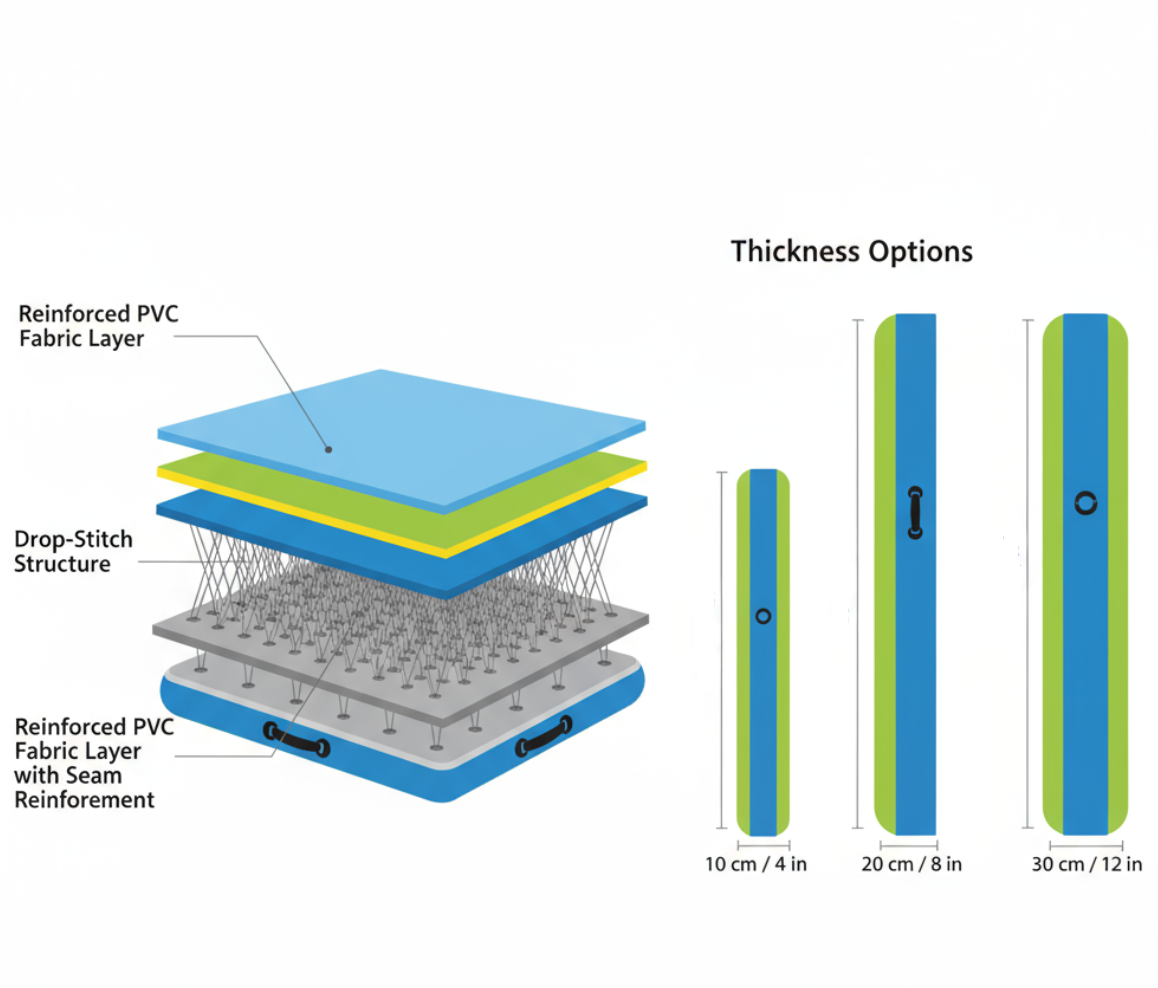
In a commercial training environment, flexibility and adaptability often determine how efficiently a space operates. That’s why B2B buyers increasingly look for tumble air track mats that include functional add-ons designed to expand usability across different programs and training setups. These small design upgrades can make a major difference in user convenience, safety, and overall product value.
One of the most popular enhancements is the Velcro connector system, which allows multiple tumble track mats to be joined together seamlessly. This is ideal for gyms that frequently adjust their layout for group classes, competitions, or special events. Similarly, handle placements and double inflation valves improve portability and setup speed — key advantages for mobile coaches and training camps.
Other advanced features include non-slip base layers, extra edge reinforcement, and custom air pressure controls, enabling trainers to fine-tune bounce levels for different skill levels or routines. These design choices not only boost the functionality of each mat but also make your inventory more appealing to institutional clients like schools, clubs, or sports distributors.
For B2B buyers, these add-ons represent more than convenience — they’re an opportunity to offer differentiated, higher-margin products. When your mats solve more real-world training challenges, your brand becomes synonymous with reliability and innovation.
If you’re ready to explore feature-rich options that maximize functionality and client satisfaction, consider starting a design inquiry through customize air tracks. It’s the most efficient way to turn practical upgrades into business value.
For large-scale buyers, distributors, or private-label brands, the biggest advantage of customization comes through ODM (Original Design Manufacturing). This model allows you to collaborate directly with manufacturers to create exclusive tumble air track mats that reflect your company’s design vision, technical standards, and branding strategy — not just rebranded stock models.
ODM partnerships enable complete control over specifications — from unique surface textures and stitching patterns to upgraded valves, packaging, and even inflation systems. For example, a gymnastics equipment distributor might develop a signature tumble track mat with a distinct color gradient and dual-layer finish that becomes a recognizable mark of quality in its market. Similarly, sports academies can co-develop mats optimized for specific training techniques, offering athletes an edge while strengthening brand differentiation.
This approach also enhances procurement efficiency. With ODM, B2B buyers can consolidate their sourcing, simplify logistics, and ensure consistent product standards across multiple regions or retail outlets. Moreover, ODM arrangements often include intellectual property protections and exclusive production rights, safeguarding your design investment from competitors.
By working closely with manufacturers, you’re not just buying — you’re co-creating. This partnership mindset transforms air track mats into brand assets rather than mere equipment. It’s an investment that drives both innovation and loyalty in a competitive marketplace.
To start exploring ODM collaboration or tailored bulk designs, you can visit customize air tracks. A consultation will help define your brand’s unique specifications, packaging, and market-ready solutions.
Transitioning from standard models to custom tumble air track mats can seem complex at first — but with the right process, it becomes a smooth and rewarding investment. For B2B buyers, the key is to approach customization strategically, ensuring every design decision aligns with business goals like brand visibility, training efficiency, and ROI.
Start by identifying your specific training or distribution requirements. Are you outfitting a gymnastics academy, retailing mats under your own brand, or supplying schools and clubs? Your end users’ needs will determine the best size, material, and branding combinations.
Work with manufacturers experienced in ODM/OEM solutions. They not only offer a range of tumble track mats and tumble air track mats but also provide design guidance, prototyping, and testing to ensure product consistency.
Consider practical factors like storage, transport, and inflation systems. Modular or foldable mats, for instance, simplify logistics and lower operational costs. Ask your supplier to recommend options that improve usability without inflating the budget.
Before full production, request a sample. Testing bounce quality, air tightness, and visual printing ensures the final product matches your expectations. Consistent quality testing protects your brand’s reputation and customer satisfaction.
Once you’re satisfied with the results, you can confidently move into bulk orders. A strong customization partnership means you can replicate or modify designs for future orders effortlessly.
If you’re ready to begin, explore customize air tracks to access a guided customization process tailored for B2B clients. From technical specs to branding upgrades, you’ll get expert support that simplifies bulk procurement and delivers long-term value.
In the competitive landscape of commercial fitness and sports training, the ability to deliver high-performing, branded equipment defines long-term success. Custom tumble air track mats represent more than a product upgrade — they’re a strategic investment in brand differentiation, operational efficiency, and client satisfaction.
From personalized logos and flexible sizing to advanced materials and ODM design capabilities, customization gives B2B buyers control over every aspect of product value. The result is equipment that not only meets professional training demands but also reinforces your brand’s credibility in every gym, studio, or retail environment.
What makes this investment truly smart is its scalability. Once you establish a trusted customization process, you can easily replicate it across different markets, launch co-branded models, or develop private-label collections that elevate your brand’s market presence. This agility helps businesses adapt quickly to evolving consumer expectations and industry trends.
In short, the right customization strategy transforms air track mats from standard training tools into strategic business assets. Whether your goal is to enhance athlete experience, boost sales, or expand brand awareness, custom designs offer the precision and professionalism your business deserves.
To bring your ideas to life, explore customize air tracks and collaborate directly with experts who understand B2B requirements. A tailored product line today can redefine your market standing tomorrow.
Q1: How long does customization take?
Production time typically ranges from 2–4 weeks, depending on order complexity, quantity, and ODM design requirements. Bulk orders with branding are often prioritized for regular B2B partners.
Q2: Can I order mixed sizes or colors in one batch?
Yes. Manufacturers can combine multiple sizes and colors in one production cycle, helping you diversify your product catalog without increasing lead time significantly.
Q3: What’s the minimum order quantity (MOQ) for ODM designs?
For standard branding, MOQs start as low as 10–20 units. For full ODM customization (unique shape, design, or structure), MOQs may begin around 50–100 units depending on the complexity.
Q4: Do custom mats affect warranty or quality assurance?
Not at all. Reputable manufacturers maintain strict quality control standards, ensuring your custom mats carry the same or even enhanced warranties compared to standard models.
Q5: Can I request design support or mockups before placing a bulk order?
Absolutely. Most suppliers provide free digital mockups or small-scale prototypes to verify colors, logos, and dimensions before mass production — ensuring full satisfaction before you commit.


![What Is an Air Track in Gymnastics? [Complete Guide]](http://ueeshop.ly200-cdn.com/u_file/UPBF/UPBF509/2605/13/photo/WhatIsanAirTrackinGymnastics.png)


