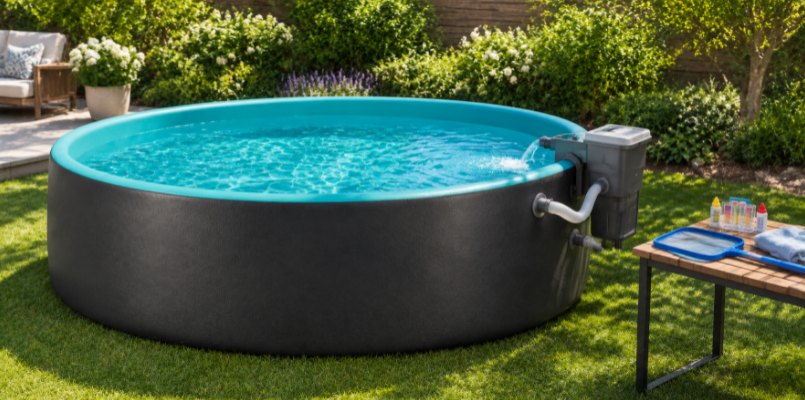
The pool arrives with an air pump, a repair kit, and a bag. It does not arrive with a water filter. That missing item explains most of the water problems people report in their first season: green water in August, cloudy water that chlorine will not fix, and a pump that runs all day without clearing anything.
This guide covers water care for the large sizes, from 2 m to 6 m, where the volumes are big enough that guesswork stops working. A 6 m pool holds 32,553 litres, which is 32.5 tonnes of water. Dosing that by eye is not the same as dosing a paddling pool.
One number drives almost every decision below: your actual water volume. Everything else scales from it.
Manufacturers quote capacity in gallons and litres at a working water level, not at the rim. Use the filled volume for chemistry and filtration maths, because that is the water you are treating.
| Model | Filled volume | Working depth | Water weight |
|---|---|---|---|
| 2 m / 6.6 ft | 500 gal / 1,893 L | about 60 cm | 1.9 t |
| 3 m / 10 ft | 1,500 gal / 5,678 L | about 80 cm | 5.7 t |
| 4 m / 13 ft | 3,000 gal / 11,356 L | about 90 cm | 11.4 t |
| 5 m / 16 ft | 5,300 gal / 20,063 L | about 102 cm | 20.1 t |
| 6 m / 20 ft | 8,600 gal / 32,553 L | about 115 cm | 32.6 t |
Fill to roughly 75 to 80% of the wall height. Below that, a hang-on filter intake starts pulling air and the pump loses prime. Above it, every extra centimetre adds load to the wall seam for no benefit, and the first person who jumps in pushes water over the edge.
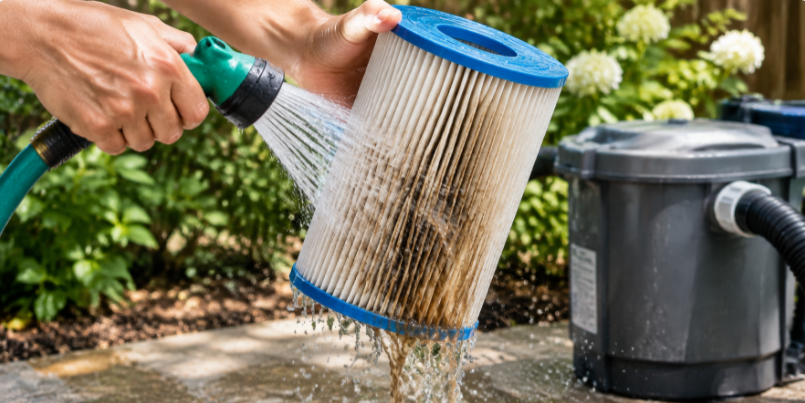
Filter flow rates are quoted in gallons per hour, usually at zero head and with a clean cartridge. Both conditions disappear the moment you hang the unit on a pool wall. Size for a real turnover, then add margin.
| Pool | Required flow at 8 h | In GPH | Filter rating to buy |
|---|---|---|---|
| 2 m / 1,893 L | 237 L/h | 63 | about 90 GPH |
| 3 m / 5,678 L | 710 L/h | 188 | about 265 GPH |
| 4 m / 11,356 L | 1,420 L/h | 375 | about 525 GPH |
| 5 m / 20,063 L | 2,508 L/h | 663 | about 930 GPH |
| 6 m / 32,553 L | 4,069 L/h | 1,075 | about 1,500 GPH |
The small sizes are forgiving. A basic 530 GPH cartridge unit turns a 3 m pool over in under three hours, which is plenty. The 5 m and 6 m pools are where cheap filters fail: a 1,000 GPH unit on a 6 m pool needs 8.6 hours for one pass with a clean cartridge, and longer as the cartridge loads. Put a sand filter on anything above 4 m if the pool runs all season.
Cartridge filters are cheaper, quieter, and easier to move, which suits a pool that gets set up and taken down. They need the cartridge rinsed every week and replaced when the pleats stay matted after cleaning. Sand filters cost more up front, handle a 6 m pool without strain, and backwash in minutes, which is why rental fleets and seasonal installations use them.
Whichever you buy, check two things before you order: the filter needs a vacuum port if you plan to vacuum the floor, and the hose diameter has to match the pool's fittings. A filter that hangs over the wall works on a pool with no built-in ports, which is common on drop stitch models. Ask your supplier whether the pool has pre-installed inlet and outlet ports before you plan the plumbing, because adding a port after production is not a workshop job.
Run the filter long enough to complete the turnover, not for a fixed two hours. For a 4 m pool at 525 GPH, that is about 8 hours. Split it into two blocks if you prefer, but do not skip a day and double the next one. Water clears on steady circulation, not on bursts.
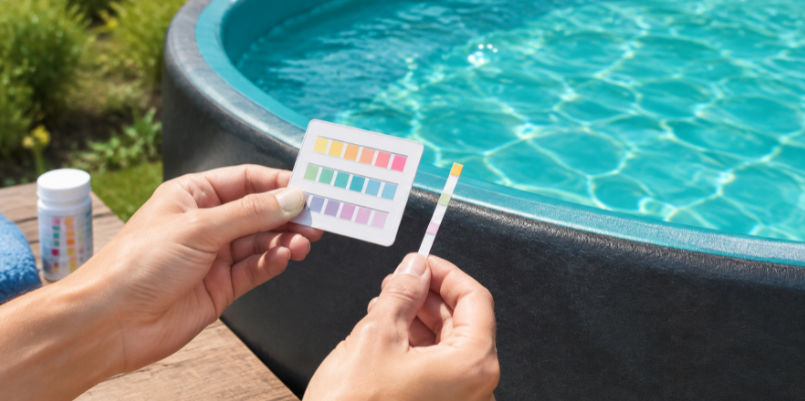
Test strips are adequate for a weekly check, and a liquid test kit is better for chlorine and pH because it reads low ranges more accurately. You need four numbers.
| Reading | Target for a residential pool | What goes wrong outside it |
|---|---|---|
| Free chlorine | 1 to 3 ppm | Below 1 ppm, algae and bacteria grow. Above 5 ppm, it irritates skin and eyes and bleaches swimwear. |
| pH | 7.2 to 7.6 | Low pH corrodes fittings and stings eyes. High pH makes chlorine ineffective and clouds the water. |
| Total alkalinity | 80 to 120 ppm | Low alkalinity lets pH swing daily. High alkalinity locks pH high and causes scale. |
| Cyanuric acid (CYA) | 30 to 50 ppm | Low CYA lets sunlight burn off chlorine in hours. High CYA stops chlorine working at all. |
Test in this order: pH first, then chlorine. A chlorine reading taken at pH 8.2 tells you very little, because most of that chlorine is not doing anything. Fix pH, wait, then dose chlorine.
If you run a salt chlorinator, follow its manual for salt level and cell output. Most units sit around 3,000 ppm of salt, and the cell only keeps up if the filter is running long enough to pass the water through it.
The dose depends on volume, and the difference between sizes is large enough that a scoop which works on a 3 m pool will under-dose a 6 m pool by six times.
| Pool | Calcium hypochlorite 65% to raise FC by 1 ppm | Liquid chlorine 10% to raise FC by 1 ppm |
|---|---|---|
| 2 m / 1,893 L | 2.9 g | 17 mL |
| 3 m / 5,678 L | 8.7 g | 52 mL |
| 4 m / 11,356 L | 17.5 g | 103 mL |
| 5 m / 20,063 L | 30.9 g | 182 mL |
| 6 m / 32,553 L | 50.1 g | 296 mL |
To shock a pool, raise free chlorine to about 10 ppm, which is ten times the figures above. For a 6 m pool that is roughly 500 g of 65% cal-hypo in one dose. Add it with the filter running, pre-dissolve granular chlorine in a bucket of water first, and pour it into the pool rather than letting granules settle on the floor where they can bleach the material.
Trichlor tablets are convenient and they raise cyanuric acid as they dissolve, roughly 0.6 ppm of CYA for every 1 ppm of chlorine they release. A pool fed on tablets all season can pass 100 ppm CYA while showing a normal chlorine reading. At that point the chlorine is present and inactive, the water turns cloudy, and adding more tablets makes the problem worse because it adds more CYA.
The fix is a partial drain and refill, not another chemical. Going from 100 ppm CYA to 40 ppm means replacing 60% of the water, which is 6,814 L on a 4 m pool and 19,532 L on a 6 m pool. Test CYA once a month if you use tablets. If you use liquid chlorine or cal-hypo as your main sanitizer, CYA stays where you put it and this problem never starts.
Most cloudy pools are a maintenance frequency problem, not a chemistry problem. This routine takes about fifteen minutes a week on a 4 m pool.
| When | What to do |
|---|---|
| Daily | Skim the surface with a net. Check the water level against the fill line. Confirm the filter is running. |
| Weekly | Test pH and free chlorine. Brush the walls and floor. Vacuum if there is sediment. Rinse the cartridge until the water runs clear. |
| Every two weeks | Deep clean the cartridge in a bucket of water with a dedicated filter cleaner. Check the hoses and the pump seal for leaks. |
| Monthly | Test total alkalinity and CYA. Backwash a sand filter when the pressure gauge reads 0.5 bar above the clean starting pressure. Check the wall seam and base rail while the pool is empty of bathers. |
| End of season | Drain, clean, dry, fold, and store. Our guide to storing an inflatable pool for winter covers the sequence and the dry test. |
Two habits matter more than the schedule. Skim before you swim, because leaves and grass sink overnight and turn into sediment. And never leave the filter off for a full day in hot weather, because warm water plus still water is the fastest route to green.
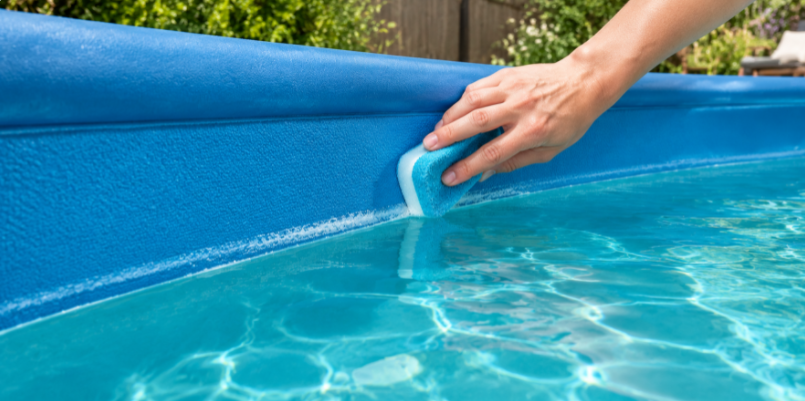
The waterline is the part owners notice last and clean hardest. Sunscreen, body oils, sweat, and a small amount of plasticiser from the PVC collect in a greasy band at the water level. A soft sponge with mild dish soap removes it. Rinse the soap off before refilling.
For the floor, use a vacuum with a soft brush head, or a venturi vacuum that runs off a garden hose if your filter has no vacuum port. Move slowly. A drop stitch floor is a flat panel under pressure, and dragging a stiff brush across grit grinds it into the coating.
Do not scrub the printed logo or the warning text with an abrasive pad. Both sit on the surface of the material, and a scrubbed logo looks worse than a faded one.
| What you see | Most likely cause | What to do |
|---|---|---|
| Green water | Free chlorine dropped near zero, usually after a hot still week or a skipped filter day | Brush the walls, shock to 10 ppm, run the filter continuously, clean the cartridge daily until the water clears |
| Cloudy white, chlorine normal | Filter not removing fine particles, or high pH, or high CYA | Clean or replace the cartridge, correct pH, test CYA before adding anything else |
| Brown or tea coloured | Well water with iron, or leaves left in the pool | Remove the debris, run the filter, use a metal sequestrant if the fill water is the source |
| Yellow dust on walls | Pollen, or mustard algae in shaded pools | Brush and shock, then check that circulation reaches the shaded corner |
| Clear water, slippery walls | Biofilm forming before the water shows colour | Brush the walls and shock. Do not wait for the water to turn |
Green water is recoverable in most cases. Draining a 32 tonne pool because the water turned is an expensive first response, and refilling with the same untreated water gets you back to the same place in a week.
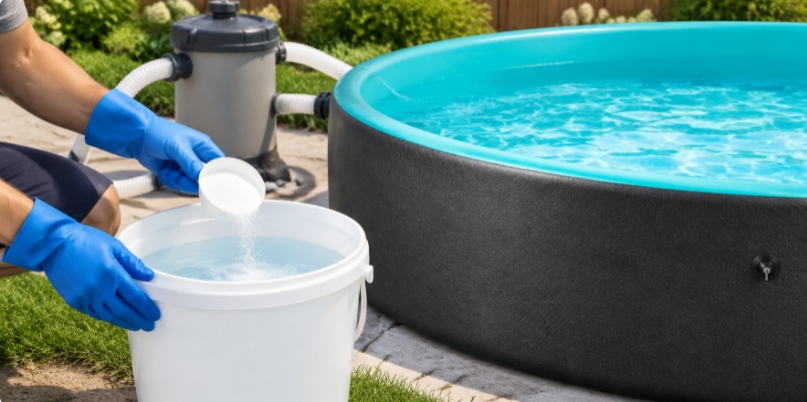
A pool does not need a full water change every season if the chemistry stays in range. Partial changes handle the two cases that matter: high CYA from tablet use, and total dissolved solids climbing after a long season. A 20 to 30% change at the start of the season covers most situations.
Let the chlorine drop before you drain. Stop dosing for three to five days, test to confirm free chlorine is below 0.5 ppm, then drain. Chlorinated water harms plants and aquatic life, and many municipalities treat pool discharge as a controlled waste. Check your local rules before you send 20 tonnes of water down a storm drain.
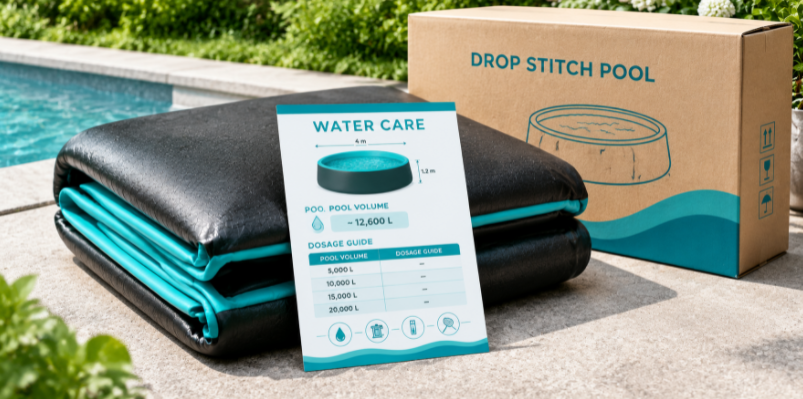
Water care drives your return rate as much as your customer service load. Most "the pool turned green" complaints trace back to a kit that shipped without a filter and a manual that did not explain turnover. Neither is a manufacturing defect, and both cost you a claim.
If you are specifying a container order and want the pool to ship with a filter, port configuration, and a printed manual in your market's language, that conversation belongs in the quote rather than in a support email after the season. Start from the DWF drop stitch pool range or the 6.6 to 20 ft series, and check the pump and repair kit accessories for what already ships in the box.
Not every season if the chemistry stays in range. Do a 20 to 30% partial change at the start of the season, and a larger change only if cyanuric acid has climbed above 50 ppm or total dissolved solids are high. A full change on a 6 m pool means replacing 32,553 litres, so test before you drain.
Three causes cover most cases: a loaded cartridge that is not removing fines, pH above 7.8 where chlorine is less effective, or cyanuric acid above 50 ppm where chlorine is present but inactive. Test pH and CYA before adding more chlorine, because more chlorine will not fix any of the three.
You can, with a caveat. Trichlor tablets raise cyanuric acid as they dissolve, and after a season of tablet feeding the CYA level can stop chlorine from working. If you use tablets, test CYA monthly. Liquid chlorine or calcium hypochlorite avoids the problem because neither adds CYA.
Long enough to turn the full volume over once, ideally within 8 hours. Divide your litres by 8 to get the flow you need in litres per hour, then compare that with the filter's rated flow, which is measured with a clean cartridge and no head loss. A 4 m pool at 11,356 L needs about 1,420 L/h, or 375 GPH.
Yes, if you keep the chemistry in range and run the filter. The material handles a full season of water. What it does not handle is water left standing without circulation, or a pool left full through a freeze. If temperatures drop below freezing, drain and store it. Our guide to how long a drop stitch pool lasts covers the use patterns that shorten service life.
The water does not care what the wall is made of, so the sizing method is the same. The difference is plumbing. Many drop stitch pools have no built-in inlet and outlet ports, so the filter hangs over the wall with hoses. Confirm the port layout before you buy a filter, and check that the hose fits the valve you have.


