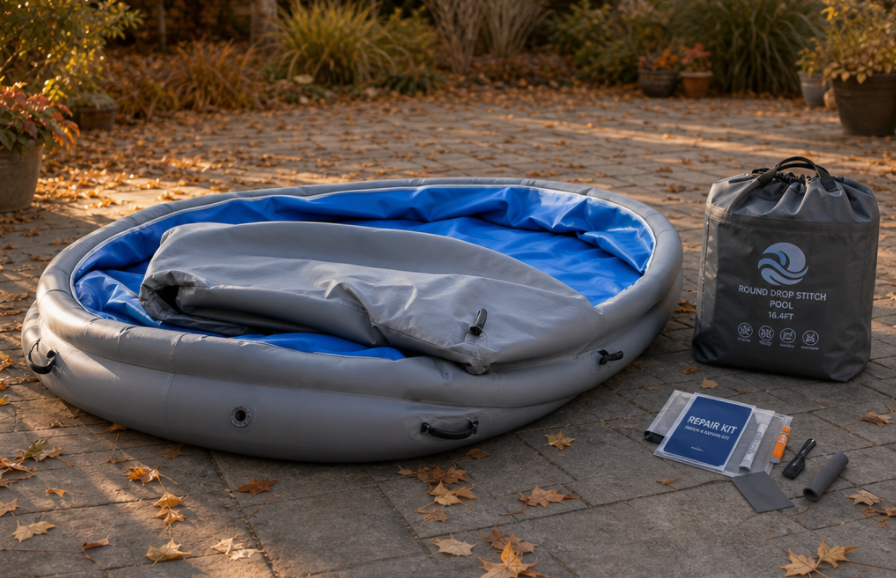
Most pools are not ruined by swimming in them. They are ruined in the six months nobody looks at them. Two mistakes cause almost all of the damage: folding the pool away while it is still damp, and folding it in the cold.
Both leave a mark that shows up next spring, when the folds have gone black or the creases have turned into cracks. By then the season is starting and the pool is already compromised.
This is the end-of-season procedure we give our own retail and rental customers. It covers draining a pool that may hold more than 32 tonnes of water, drying it properly, folding it so the material survives, and storing it somewhere that will not undo the work. Allow two to four hours for a large pool, plus a day of drying in between.
First Decision: Store It, or Leave It Up?
You have three options, and the right one depends on your winter, not on your storage space.
| Option |
Works when |
What it takes |
Main risk |
| Drain and store it dry |
Any climate, and the only safe choice where it freezes |
2 to 4 hours plus a full drying day |
Storage space, and doing it badly |
| Leave it up, filled and treated |
Mild winters with no hard frost |
Cover, water treatment, filter running all winter |
Algae, UV, and ice if the weather turns |
| Leave it up, empty and covered |
Mild winters, tight storage space |
Drain, dry the inside, cover and tie down |
Wind damage, rodents, flapping that abrades the wall |
The dividing line is freezing. Water expands when it turns to ice, and ice pressing against a drop stitch wall loads the floor-to-wall seam and the reinforced base rail, which are the two places you cannot repair in the field. If your winters go below zero, drain the pool. That is not a preference, it is the difference between a pool that comes back out in spring and one that does not.
If you are in a mild climate and plan to leave it up, read our answer on how long a drop stitch pool lasts first. Standing water, sun, and no maintenance over winter is the fastest combination there is, and it moves a pool straight to the bottom of the lifespan range.
Step 1: Drain the Pool
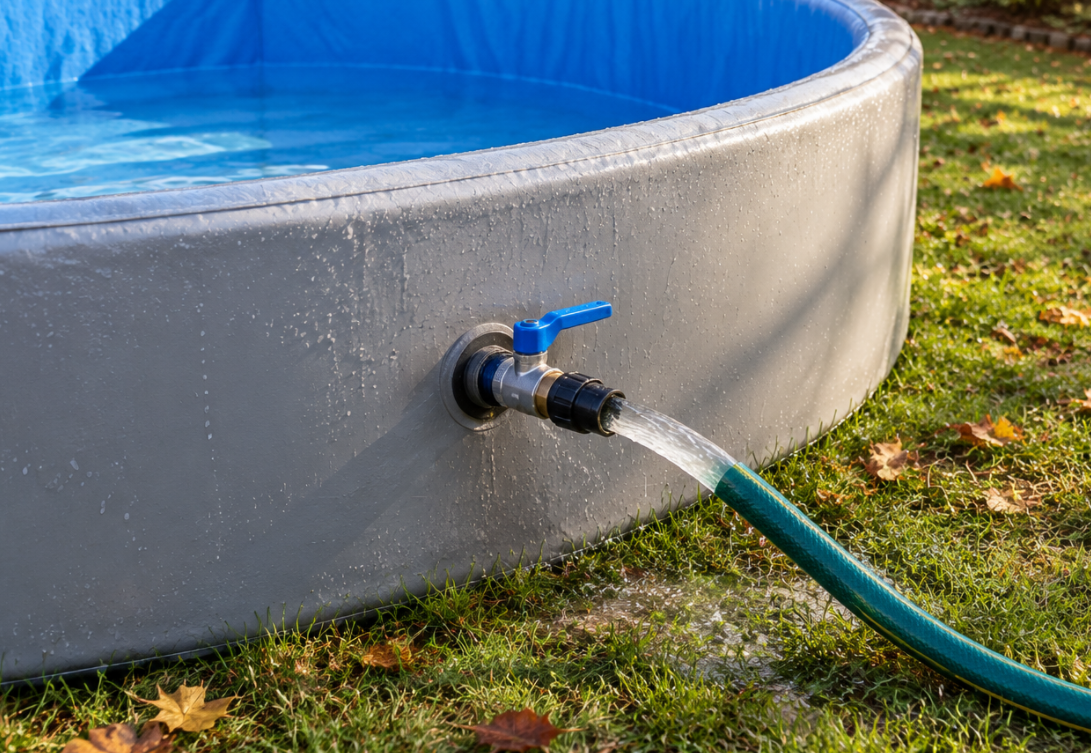
Open the drain valve fully, and open the inflation valve too. Water cannot leave fast if air cannot get in behind it. Take the pump off and put it somewhere dry before you start.
The commercial series uses high-capacity drain valves, which is the reason teardown is quick on those models. The reason draining still takes planning is the volume sitting in the pool.
| Model |
Filled volume |
Weight of the water |
Gravity drain time |
| ∅200 × 80 cm |
500 gal / 1,893 L |
about 1.9 tonnes |
under 20 minutes |
| ∅300 × 100 cm |
1,500 gal / 5,678 L |
about 5.7 tonnes |
30 to 60 minutes |
| ∅400 × 120 cm |
3,000 gal / 11,356 L |
about 11.4 tonnes |
1 to 2 hours |
| ∅500 × 130 cm |
5,300 gal / 20,063 L |
about 20.1 tonnes |
2 to 3 hours |
| ∅600 × 150 cm |
8,600 gal / 32,553 L |
about 32.6 tonnes |
3 to 5 hours |
Those times assume a typical gravity flow through the open drain valve, with the filler cap open and a short run of hose. A long hose, a flat run, or a partly blocked valve will all slow it down, so add a submersible pump if you are working to a schedule. One litre of water weighs one kilogram, which is why the last few centimetres of a large pool are heavier than they look.
Three things to get right while the water is going out:
- Never drag a part-filled pool. The base rail carries the point load, and the 1000D PVC rail layer will hold a lot, but sliding a pool with a few tonnes of water still in it is the fastest way to tear the floor-to-wall join.
- Plan where the water goes. A large pool puts a lot of chlorinated water on the ground in one go. Let the chlorine level fall before you drain, and check your local rules if you are discharging to a storm drain or a watercourse.
- Get the last of it out with a pump or a towel. Do not leave standing water in the low spots, because that is where the drying step starts from behind.
Step 2: Clean It While It Is Still Soft

Clean the pool before it dries, because a dried scum line is harder to lift than a wet one.
- Rinse the inside with fresh water. Use mild soap on the waterline and a soft brush. No solvents, no alcohol, no abrasive pads, because they strip the coating that the seams and patches bond to.
- Work the valve recess with a soft cloth. Dried chlorine and grit sit in the seal through the season, and that residue is behind a large share of the air leaks we get asked about. If you find grit or a damaged seal, this is the cheap moment to deal with it rather than next June.
- Rinse the outside, especially the base rail, which collects sand and grit all season.
- If you can already see black spotting in the folds, clean it now. Mold that goes into storage comes back bigger.
- Leave both valves open while you work so water does not pool around the seals.
If you find a puncture while you are cleaning, fix it before the pool goes into the bag. It takes twenty minutes now and stops the leak getting worse in storage, and our drop stitch pool repair guide covers the patch steps and the cure time.
Step 3: Dry It Completely
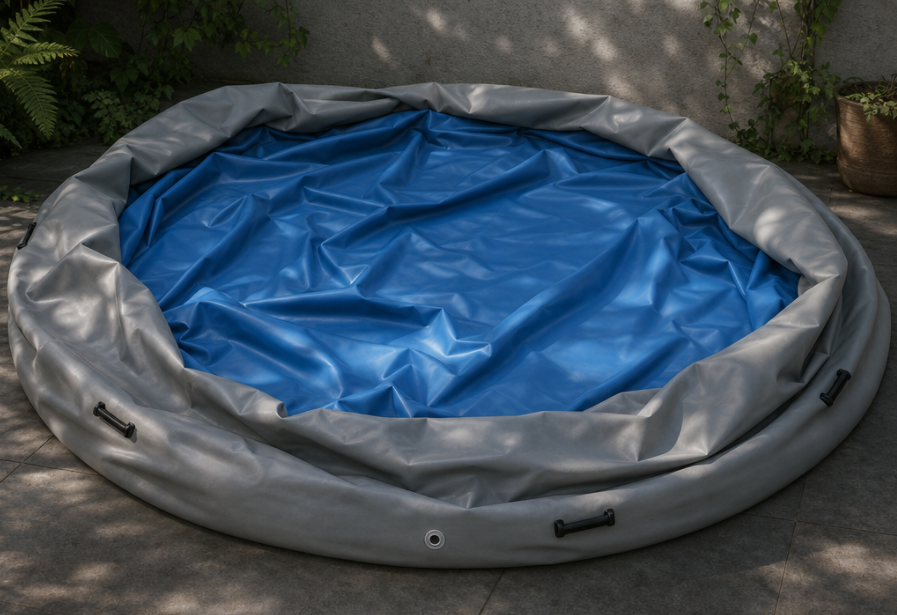
This is the step people rush, and it is the one that decides what the pool looks like next season. Trapped moisture and warmth grow mold inside the folds. A pool folded away damp in September is often black by March.
- Lay the pool out flat, inside facing up. A driveway or a patio works, or a lawn if it is dry.
- Work in shade with airflow rather than full sun. Sun dries the surface quickly and leaves the fold channels wet, and the UV exposure is the thing you are trying to reduce. Shade with a breeze dries the pool more evenly.
- Open the folds and prop them apart. Water hides in the wall-to-floor join, in the valve recess, and in the channels between folds.
- Give it a full day, and turn it once. A large pool needs two sessions, one for each side.
The dry-hand test: run a dry hand along the floor-to-wall join and into the valve recess. If your hand comes away damp, the pool is not ready to fold. Wait, and check again in an hour. This one check prevents most mold problems.
Do not use a hairdryer, a heat gun, or a space heater to speed this up. Heat softens the coating and stresses the heat-welded seams, and a distorted coating cannot be repaired. Air movement does the job without the risk.
Step 4: Fold It So It Does Not Crack

A fold is a permanent instruction to the material. Make it once, in the same place, every year, and the coating eventually cracks along that line. The goal is to spread the stress and keep the bends gentle.
- Fold on a clean, smooth surface. Not on gravel, not on rough concrete, and not on grass with twigs in it.
- Deflate fully and press the remaining air out. Valves open. A pool that is folded with air in it will not sit flat in the bag.
- Start at the valve and fold the pool onto itself, keeping the wall straight instead of bent back on a sharp angle.
- Fold loosely. A tight fold that sits under weight for months is where creasing cracks begin.
- Change the fold line each year. Shift the creases a hand's width from the previous season so the same line does not take the stress twice.
- Keep the base rail out of hard bends. The reinforced rail layer is the stiffest part of the pool and it does not like being creased against itself.
- Pack the repair kit, wrench, and patch material in the bag with the pool. Matching patch material is what makes a repair hold, and it is the one part people lose between seasons.
One temperature rule: fold in mild weather if you can. Cold PVC is less flexible and records a crease more permanently than warm PVC, so a pool folded on a freezing day keeps that shape.
Step 5: Store It Somewhere That Stays Dry
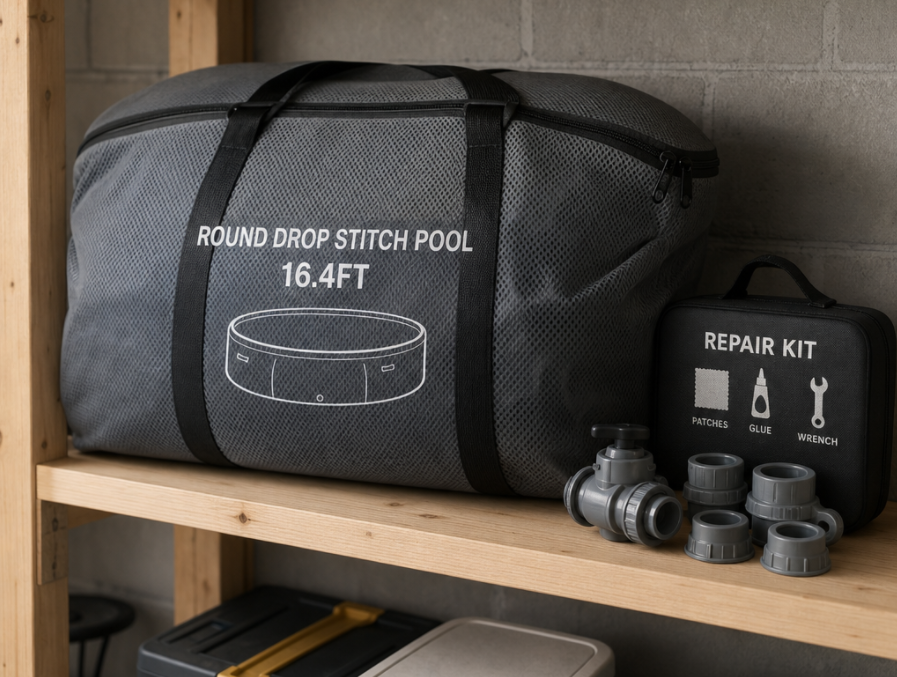
The storage place matters as much as the folding. Every AfterSea pool ships with a heavy-duty storage bag, and the bag is ventilated on purpose.
- Cool, dry, out of direct sunlight. A garage, a shed, a spare room. Sunlight on a stored pool ages the coating for no reason.
- Off the ground. A shelf, a pallet, or a couple of boards. Bare concrete pulls moisture into anything sitting on it.
- Never beside chemicals or fuel. Fertilizer, paint, solvents, and pool chemicals give off vapour that PVC absorbs. The smell stays in the material and does not wash out.
- Away from animal feed. A shed corner with birdseed, pet food, or garden waste attracts mice, and mice chew through PVC walls.
- Nothing stacked on top. Weight on a folded pool sets the creases.
- Do not seal the bag shut. The ventilated bag lets any remaining damp escape. Taping it closed traps that moisture against the fabric.
- Check it once in mid-winter. Open the bag, feel for damp, and air the pool out if you find any. Five minutes in January beats a mold problem in April.
If You Leave the Pool Up Instead
This only works where the temperature stays above freezing, and it takes more attention than storage, not less.
- Keep the water treated and the filter running. A pool that is standing and untreated grows algae within weeks.
- Cover it and tie the cover down. A loose cover flaps in the wind and abrades the wall, which is worse than no cover at all.
- Take the ladder, toys, and floats out of the water. Anything left standing in a pool leaves a stain ring on the interior.
- Keep leaves and debris out. Rotting leaves in a full pool are a chemistry problem you will spend the spring fixing.
- Watch the forecast. If a hard frost is coming, drain it even if it is the middle of winter. Ice against the wall is what damages these pools, not cold air on its own.
Five Storage Mistakes That Cost a Pool
- Folding it wet. The most expensive mistake on this list, and the most common.
- Folding it in freezing weather. The crease becomes permanent and cracks from that line.
- Storing it on bare concrete. Moisture from the floor sits in the bottom of the bag all winter.
- Storing it beside pool chemicals, fuel, or fertilizer. The vapour is absorbed and cannot be removed.
- Putting the wet pump away with the pool. Drain the pump, dry it, and store it separately. A pump put away wet is usually a pump that does not start next spring.
A Note for Retailers and Rental Fleets
End of season is when you find next season's problems, and it is the cheapest time to deal with them. For a rental fleet, a unit lost to mold is a lost season, not a lost pool.
The routine that works looks like this:
- Check every pool before it goes into storage. Inflate, run a pressure check, look at the valve and the base rail. Tag anything soft instead of discovering it in June.
- Repair defects before storage, not after. A patch needs 24 hours of cure time, which you have in October and do not have on the morning of a booking.
- Count your consumables. Spare valves, patch material, and adhesive have long shelf lives and short lead times if you run out mid-season.
- Order spares with your next container. Attaching a box of repair kits to a pool order costs far less than air-freighting one in summer.
- Store by size, on a rack, labelled. A fleet that is stacked loose in a corner gets damaged twice: once by the folding, once by the handling.
If you buy pools for resale, the same logic applies to your customers. A printed storage card in the box, or this page linked from your product listing, removes a category of warranty conversation before it starts. A pool stored properly is a pool that gets bought again from the same supplier.
Frequently Asked Questions
Can I leave my inflatable pool up all winter?
Yes, if your winters stay above freezing and you keep the water treated, the filter running, and the pool covered. If you get hard frosts, drain it. Ice expanding against a drop stitch wall loads the floor-to-wall seam, and that is a factory repair or a write-off rather than a patch job.
How long does it take to drain a large inflatable pool?
A ∅200 cm pool drains in under 20 minutes by gravity. The ∅600 × 150 cm model holds 8,600 gallons, or about 32,553 litres, and takes three to five hours through the drain valve with a typical hose run. Add a submersible pump if you cannot wait that long.
What happens if I store my pool while it is still wet?
Trapped moisture and warmth grow mold inside the folds. The folds also set into the coating while damp, and those creases crack over the following seasons. Black fold lines and crease cracks are both storage damage, not manufacturing faults, so they are not covered by warranty.
Can I store a drop stitch pool in a garage that freezes?
A dry, folded pool handles cold storage better than a pool left out full of water, but a hard freeze still makes PVC stiff and brittle. Insulate it from the floor, keep it off bare concrete, and avoid moving or unfolding it while it is frozen. If you have a frost-free option, use it.
How do I stop mold in a stored pool?
Three things: dry the pool fully using the dry-hand test on the floor-to-wall join, fold it loosely so air can still move between the layers, and store it in a ventilated bag off the ground. Check it once in mid-winter and air it out if you find damp.
Do I need to do anything to the pump and valves?
Yes. Open both valves and let them dry before storage, and drain and dry the pump separately rather than packing it with the pool. Clean the valve seal while you have access to it, because grit and chlorine residue in the seal is the most common cause of an air leak next season.
Planning a winter storage programme for your fleet or your customers? Tell us the sizes and quantities you are working with, and we will send the teardown guidance, storage bag specification, and spare parts list with a factory-direct quote. Start from the
DWF drop stitch pool range or the
6.6 to 20 ft commercial series, and browse the full
above ground pool collection. OEM and ODM orders are welcome, with storage bags, repair kits, and printed after-care documentation built to your spec.


