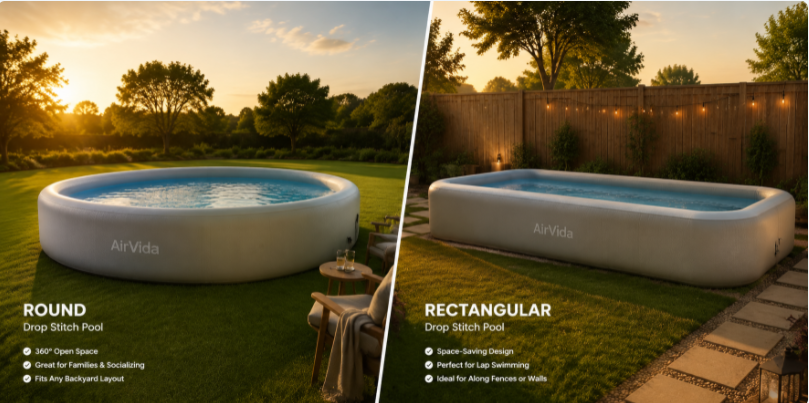
Of all the questions buyers send us, the shape question comes up most often. "Do you make a rectangular one? My customers keep asking." The short answer is yes, we build them to order. The useful answer is about what those customers actually need, because a round drop stitch pool and a rectangular one are not two versions of the same product. They sit in different parts of the market, with different cost structures, different lead times, and different buyers.
This guide explains the structural reasons behind that split, where each shape genuinely wins, and how to match the shape to the market you sell into. If you are still deciding which sizes to stock, our earlier drop stitch pool size guide covers the round range from 2 to 6 m in detail; this piece focuses on shape as a business decision.
Put a round and a rectangular pool side by side with the same wall height and the same water volume, and the swimming experience is close. The differences that matter are the footprint and the structure.
A round pool has no orientation. It reads the same from every angle, tucks into a corner, sits in the middle of a yard, or drops into a rental property without fuss. Its weakness is the opposite of that flexibility: a circle wastes the corners of any square or rectangular space, which matters more in narrow urban yards than in open suburban lots.
A rectangular pool fits where a circle cannot. Along a fence line, against the house wall, on a deck, or in a long side yard between two buildings. It also gives swimmers a lane feel that a circle never will. Its weakness is structural, and it is the reason this whole article exists.
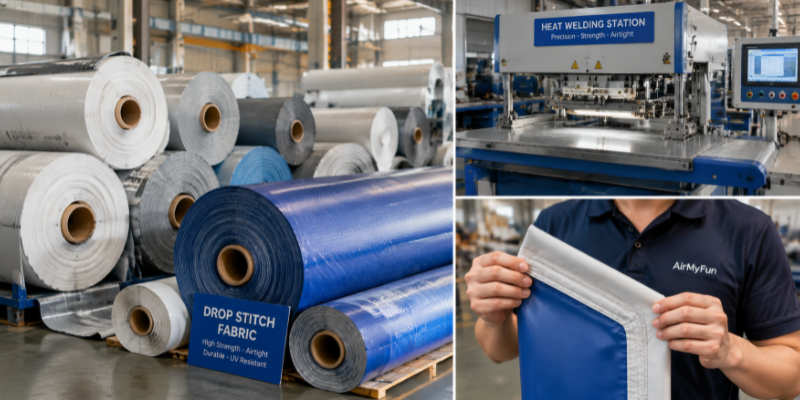
Drop stitch fabric is load-bearing. The thousands of internal threads hold the two outer layers at a fixed distance, which is what lets a wall stand vertical under water pressure instead of bulging. That construction has a favorite shape, and it is the cylinder.
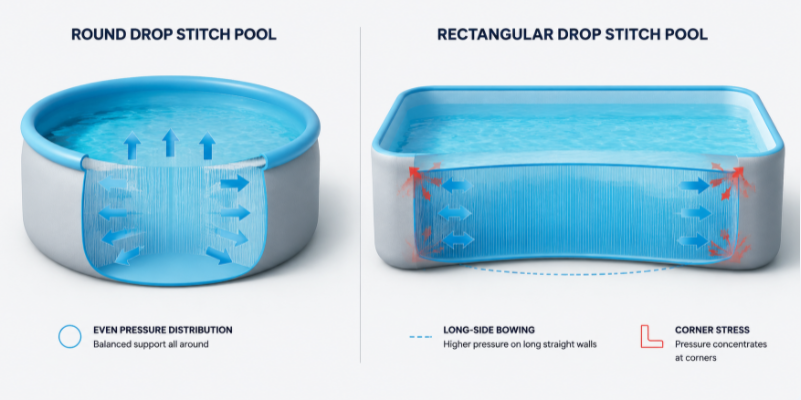
In a round pool, water pressure acts evenly on every part of the wall, and every part of the wall resists it the same way. The threads pull in tension around the whole circumference, with no point taking more load than another. That even distribution is why round is the natural, lowest-cost configuration for drop stitch construction.
A rectangle breaks that symmetry in two places. Corners concentrate stress, because the wall changes direction sharply and the fabric has to hold two different load paths at once. And the middle of each long side wants to bow outward, since it spans the widest unsupported distance. A factory compensates with denser thread spacing, wider heat-welded seams, and extra corner reinforcement, all of which add material and labor before a single pool is assembled.
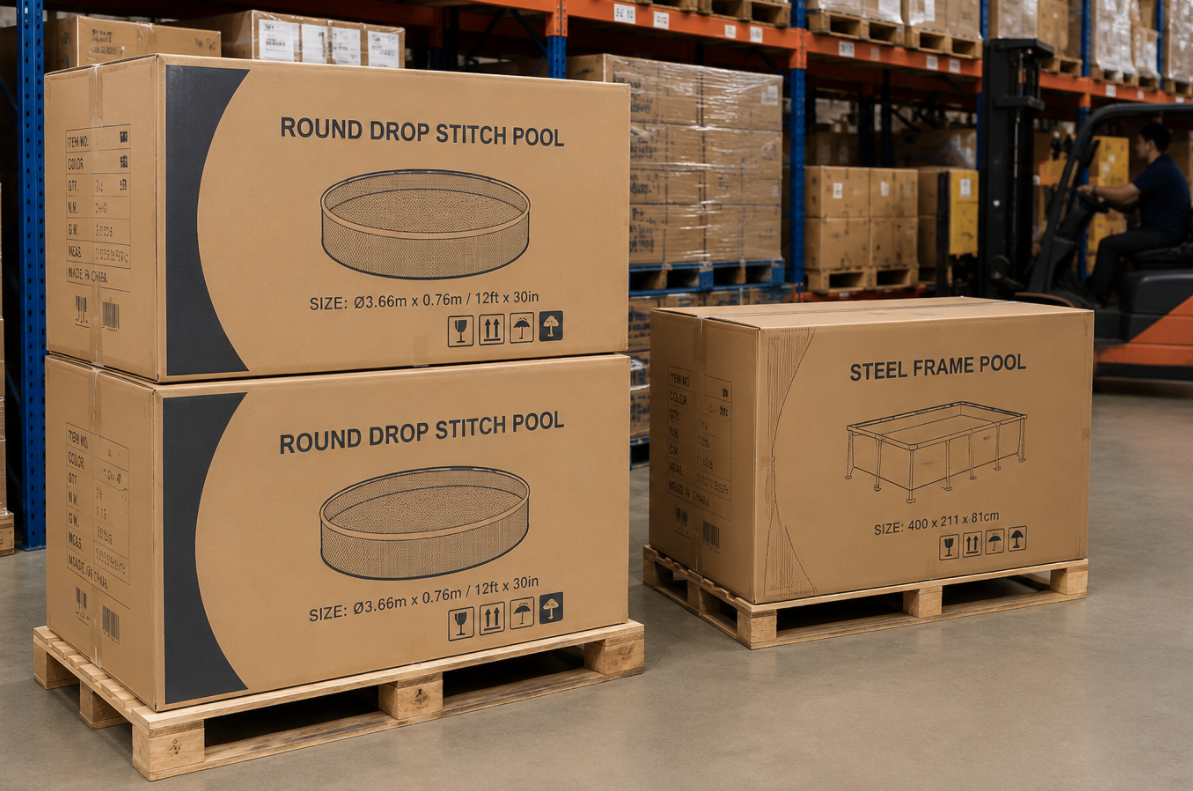
That is why you will not find rectangular drop stitch pools in anyone's standard catalog, and that includes the brands you see in every big-box retailer. Walk the pool aisle at any large store and you will find plenty of rectangular inflatable pools, but check how they are built. Nearly all of them are steel-frame pools with a PVC liner. The frame carries the water load and the liner only holds water. The wall does not need to bear weight, so the shape costs nothing extra. A drop stitch wall is the opposite: it is the structure, so the shape penalty is real and it lands on the retail price.
At AfterSea, our stocked drop stitch line is entirely round for this reason. The drop stitch pool product line runs from 200 cm to 600 cm in diameter across three wall heights, 50 cm, 80 cm, and 120 cm, built from 0.7 to 0.9 mm mesh PVC with heat-welded seams. Round is what we can price competitively and ship from stock. Rectangular drop stitch is a different product with a different cost sheet.
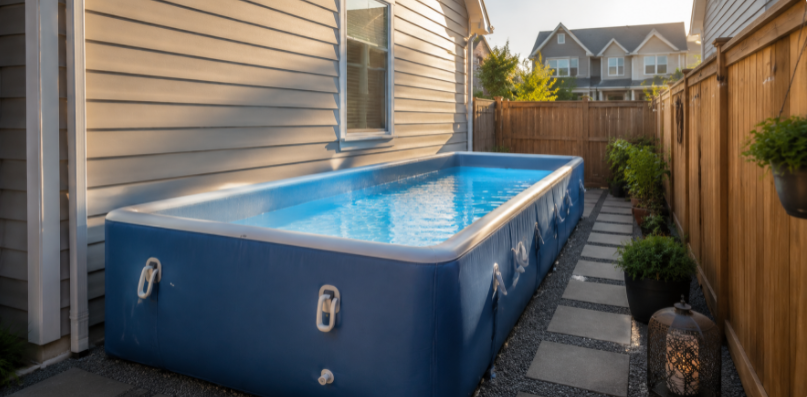
Rectangular drop stitch pools are built to order, and they sell in narrow, specific niches where the footprint is worth the price premium.
Every one of these is an OEM or ODM project. You send three numbers, length, width, and wall height, and the factory adjusts thread density and corner reinforcement to your exact footprint before quoting. Lead time and MOQ are higher than for stock rounds, and the price reflects the extra material and engineering. That is the honest trade: you pay for a footprint no stock product can fill.
If your rectangular demand is about having a rectangle in stock rather than a custom project, the market's answer is a steel-frame pool, and ours is no different. The 5 m rectangular steel-frame pool ships as a standard item, and for larger or site-specific commercial layouts we also build customizable rectangular metal-frame pools for water parks. Both give you the rectangle without the load-bearing wall premium.
The shape that fits your market is really the shape that fits your channel. Here is how the demand splits in practice.
Notice what is missing: almost nobody restocks rectangular drop stitch pools as a commodity. The demand exists, but it is project-shaped, not SKU-shaped.
| Round drop stitch | Rectangular drop stitch (OEM) | Rectangular steel-frame | |
|---|---|---|---|
| How the wall holds water | Drop stitch fabric is the structure; load spreads evenly | Drop stitch fabric carries the load, with extra corner and long-side reinforcement | Steel frame carries the load; PVC liner only holds water |
| Stock availability | Standard catalog, ships from stock | Made to order against your dimensions | Standard catalog |
| Cost structure | Lowest per liter of any rigid-wall inflatable | Highest, due to thread density, seams, and custom tooling | Mid-range; competitive at larger rectangular sizes |
| MOQ and lead time | Low MOQ, often from 10 units | Project-based MOQ and longer lead time | Standard wholesale MOQ |
| Best spaces | Open yards, rental fleets, family use | Narrow linear sites, spa and therapy setups, swim lanes | Rectangular backyards, decks, commercial layouts |
| Who buys it | E-commerce sellers, dealers, rental operators | Resorts, wellness centers, project buyers | Retailers, dealers, water parks |
Container loading is the one variable that does not fit neatly in a table, because packing choice moves it more than shape does. Palletized round pools load differently from bulk-packed ones, and rectangular products stack differently again. For a firm number on your size mix, ask for a container loading plan with your quotation rather than trusting a generic figure.
Run your situation through these four questions in order.
One piece of advice from the factory floor: if you are importing drop stitch pools for the first time, do not open with a rectangular custom order. Test your market with round standard models first. Rounds get you stock, competitive freight, fast replacement stock, and a repair ecosystem that works across the whole range. Once you have evidence that a specific rectangular size sells, a custom run is a much safer bet.
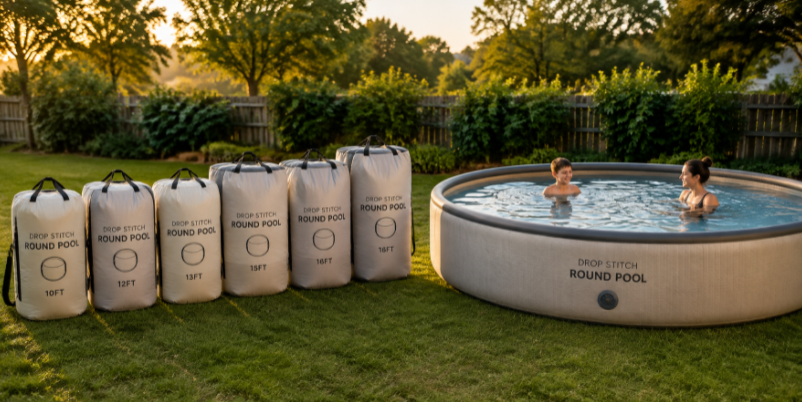
The practical lineup for most importers looks like this: carry round drop stitch pools as your core inflatable range, offer rectangular steel-frame pools for the customers who need a rectangle today, and route genuine rectangular drop stitch demand into OEM projects.
All of it starts with the same conversation, so tell us what you are planning and we will come back with a quotation and a container plan. Browse the 6.6 to 20 ft drop stitch pool series or the full above ground pool collection, and send your size mix and target market. We will tell you honestly which shape fits it.
Yes, but they are built to order, not stocked. Rectangular drop stitch pools are made against your length, width, and wall height, with reinforced corners and long sides. Most rectangular demand in the retail market is served by steel-frame pools instead.
For most backyard buyers and most resellers, round is better: it costs less per liter of water, distributes pressure evenly, and is available from stock. A rectangle only wins when the available space is long and narrow, or when the buyer wants a deliberate, lane-like layout.
Because a rectangle concentrates water pressure at its corners and long-side midpoints. A steel frame carries that load cheaply, while a load-bearing inflatable wall has to be overbuilt to handle it, which is why rectangular drop stitch pools cost noticeably more.
Not as a standard catalog item. Rectangular drop stitch pools are OEM or ODM orders quoted against your dimensions. If you need a rectangular pool that ships from stock, a rectangular steel-frame pool is the standard route.
Yes, in factory cost and retail price, for the same footprint. The extra thread density, seam reinforcement, and custom sizing all add material and labor. The premium buys you a footprint that no round pool can fill.
Standard round models run from 200 cm to 600 cm in diameter, with 50 cm, 80 cm, or 120 cm wall heights. Larger rounds and custom shapes are possible through OEM projects.


