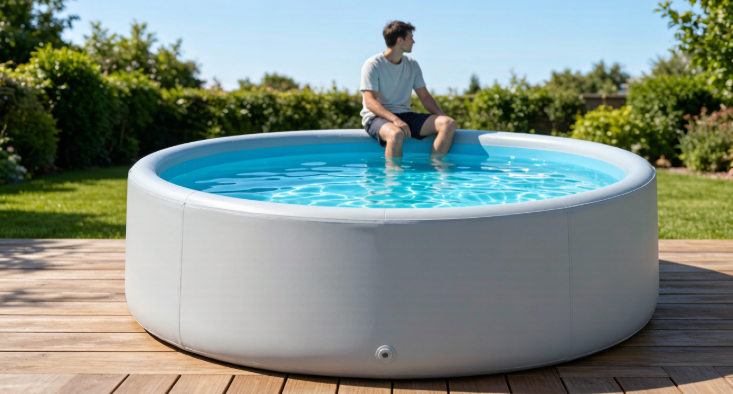
Most buyers still picture a thin vinyl ring when they hear "inflatable pool." The kind that wrinkles the moment someone leans on the wall. Drop stitch construction ended that picture. The method that stiffened paddle boards now builds pools with walls firm enough to sit on.
If you run a retail store, a distribution business, or specify gear for a gym or resort, this change touches your margin. A pool that holds its shape means fewer returns, fewer warranty claims, and a product people recommend to friends. This guide explains how drop stitch pools work, how they stack up against framed and PVC models, and what to verify before you commit to a supplier. For the deeper technical side, our drop stitch buying guide covers rated pressure and thread density in detail.
Two years ago a buyer asking for a rigid inflatable would have been shown a frame pool. Now the same request points to drop stitch. The category grew because the build solved a real complaint: walls that caved in under a kid's weight.
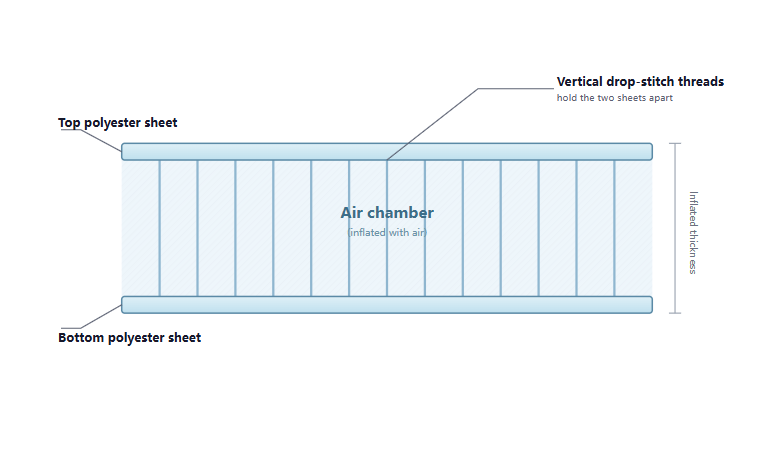
A drop stitch pool is built from double-wall fabric, often called DWF. Two sheets of coated polyester sit parallel, held apart by thousands of fine threads running straight between them. You pump air into the chamber between the sheets. The threads stop the top and bottom from spreading, so the surface stays flat and rigid instead of bulging like a balloon.
The wall feels firm underfoot, not soft like a beach toy. Walk to the edge and it holds. That stiffness is why these pools now sit beside steel-framed and rigid above-ground models for home and light commercial use.
Backyard families use them as seasonal swim pools. Gyms place them as cold-plunge recovery tubs. Resorts set them on decks for guests. The same core fabric scales from a small kids' pool to a 1.5-meter-deep plunge, because the thread grid sets the shape, not the air volume alone.
Most drop stitch pools for homes run 8 to 16 feet long and 30 to 50 inches deep. The thread grid holds that size without internal supports, which is why you can step in without the floor lifting toward the surface. A standard inflatable ring needs a thick wall of air to do the same job, and still feels soft.
Drop stitch means exactly what the name says. Two fabric layers are joined by vertical threads, tens of thousands per square meter. Inflate the chamber and air pressure pushes outward on both walls. The threads carry the load and hold the gap between the layers fixed.
Pressure is the key number. A solid drop stitch pool runs at 10 to 15 PSI. At that level the wall acts like a panel. You can sit on the rim without it folding. Standard PVC pools never reach that stiffness because they lack the internal thread network that resists the bulge.
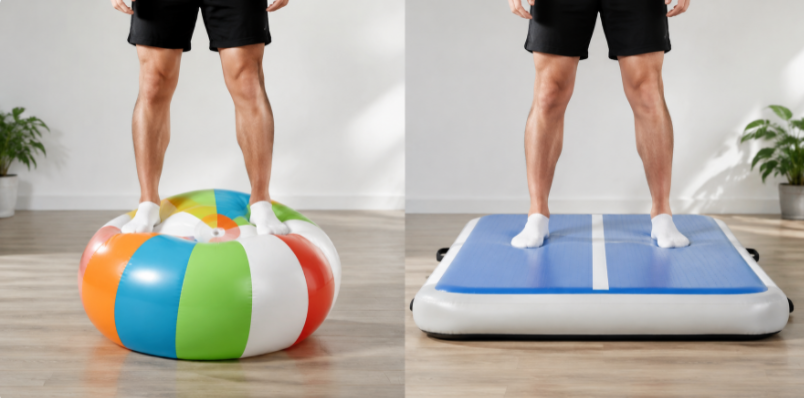
Think of a beach ball with no internal threads. Pump it up and it rounds out, soft under any load. Drop stitch adds that internal support, which holds the shape under weight. That is the whole trick, and it explains why the surface stays walkable.
A good unit loses less than 1 PSI per day once inflated. That slow leak rate means you top up once a week, not every morning. Cheap PVC pools can drop several PSI overnight because the seam itself stretches as the air pushes on it. The thread grid removes that stretch, so pressure stays where you set it.
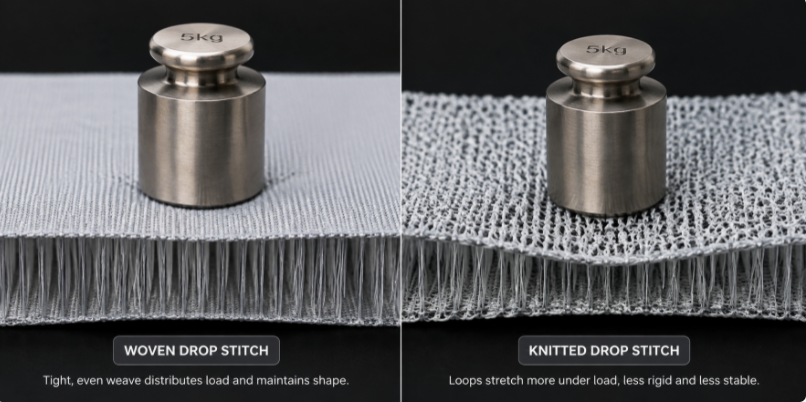
Most drop stitch fabric made before 2024 was knitted. Knitting worked, but the loops stretch, so the material needed more PVC coating to stay airtight. That made early pools heavier and a bit bouncy underfoot.
Woven drop stitch changed the trade-offs. The threads run in a tighter, less stretchy weave. At the same 10 PSI, a woven wall sits firmer than a knitted one. Makers also report woven builds come out up to 20% lighter because they need less coating. Less stretch also lowers the odds of a seam letting go after a season of sun and handling.
For buyers, the practical takeaway is direct. Ask whether the fabric is woven. The answer tells you a lot about weight, stiffness, and how the pool will age.
Woven fabric costs more per meter at the mill, but it ships lighter and returns fewer defects. For a brand building a private label, the lower return rate often pays back the material premium within the first season. When a supplier cannot name the weave type, treat that as a signal to keep looking.
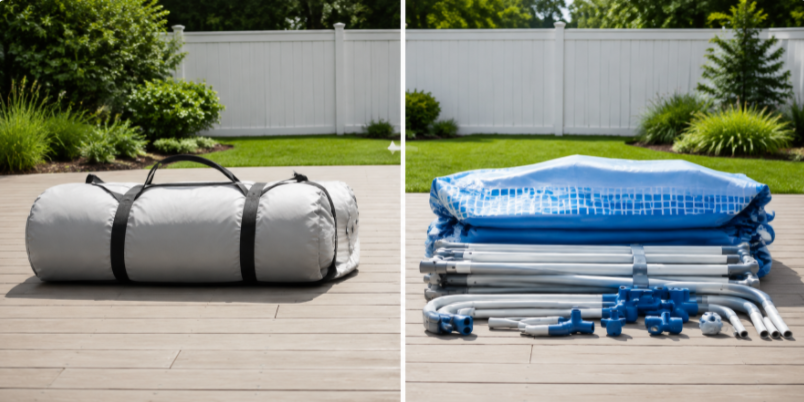
Steel-framed pools have a place. They cost less per gallon and suit permanent backyard setups. They also need assembly, eat storage space in winter, and rust at the joints.
A drop stitch pool rolls into a duffel. One person moves it, sets it up in minutes, and packs it away. For renters, seasonal businesses, and resorts that reconfigure space, that portability is the main draw. See our framed pool comparison for the full breakdown.
If your customer wants a fixed install and the lowest price, send them to a frame model. If they want to use the pool for three months and store it the rest of the year, drop stitch is the better fit.
A 12-foot frame pool takes two people roughly an hour to assemble and needs a level patch of ground. The drop stitch version sets up in under 15 minutes with one person and packs into a 30-kilogram roll. For a resort swapping layouts between seasons, that difference shows up in staff hours and in the off-season storage bill.
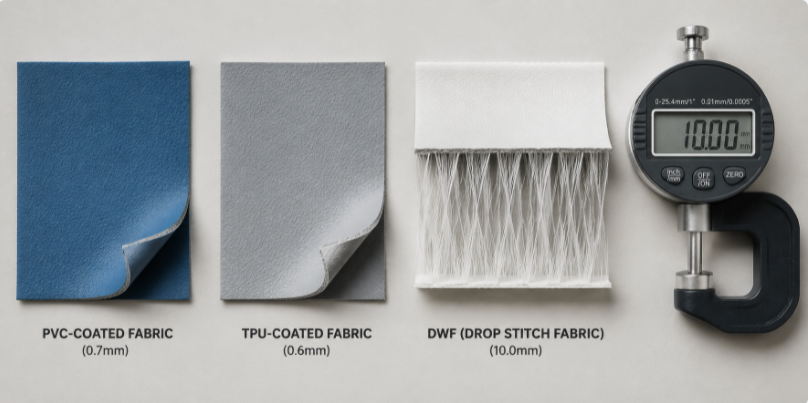
The fabric choice drives both price and lifespan. PVC-coated DWF is the common pick. It resists punctures and shrugs off chlorine and bromine. TPU-coated fabric costs more but stays flexible in cold weather and breaks down more cleanly at end of life.
Check the outer layer thickness, measured in denier or millimeters. A shell around 0.5 to 0.9 mm handles backyard use. Commercial settings should spec thicker. Fusion welding, where heat bonds the layers instead of glue, cuts the chance of seam failure. Ask any supplier which method they use before you weigh quotes. Read our drop stitch vs PVC piece for a side-by-side on materials.
Entry backyard shells often use 500 to 700 denier outer fabric. Commercial deck pools from established suppliers spec 1000 denier or higher. The number shows up in the spec sheet, and it tracks directly with how many seasons the pool survives outside. Do not accept a quote that leaves denier blank.
Drop stitch pools outlast standard inflatables by a wide margin. The thread core means the wall does not lean on a single glued seam. UV-blocking coatings slow the chalking and cracking that kills cheap PVC after one summer.
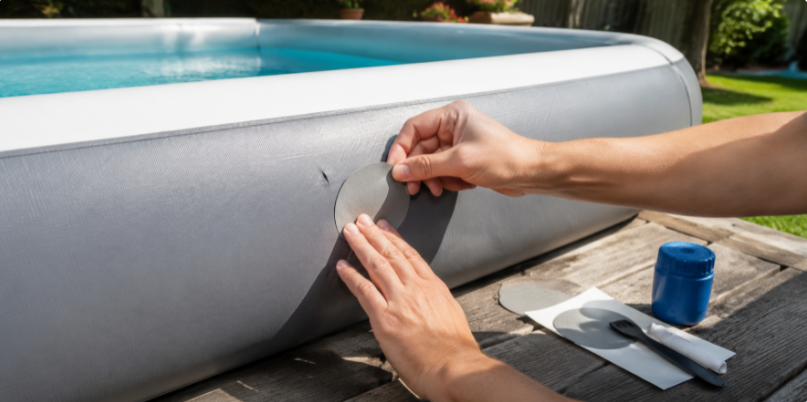
Care stays simple. Rinse after use in chlorinated or saltwater, dry before folding, and store flat in a cool space. Patch kits fix small punctures in minutes. Keep the pump clean and check pressure at setup. Most field failures trace back to overfilling past the rated PSI or leaving the pool up through a hard freeze, not to the fabric itself.
Run a light, bleach-free sanitizer and brush the walls weekly during use. At season end, deflate to half, fold along the original creases, and store indoors above freezing. Pools left inflated through a freeze crack at the seam where water sits, and that damage is not covered by warranty. A ten-minute closeout routine each fall saves a pool the next spring.
Three groups drive most orders. Retailers add them as a step up from basic ring pools. Gyms and recovery studios buy them as cold-plunge tubs. Resorts and marinas use them as deck or dock pools that staff can move.
Each group cares about different specs. Retailers watch return rates. Gyms watch floor feel and chill retention. Resorts watch setup time and how the pool looks on a deck. Knowing your buyer shapes which model you stock.
Retailers sell these as a step up from ring pools, often priced two to three times higher with far fewer returns. Gyms buy them at 1 to 1.5 meters deep for cold plunges, where the insulated air gap between the walls keeps water cold longer than a hard tub. Resorts clip them to docks for day use and pull them in at night, which a steel frame model cannot do.
If you buy for resale, a short checklist protects your name. Review our sourcing red flags before you sign.
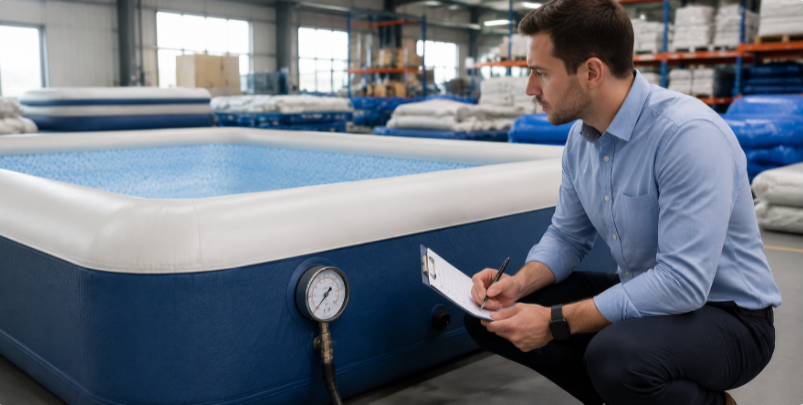
Request the rated pressure and the thread density per square meter. Low numbers there signal a soft, saggy pool that earns one-star reviews. Confirm the seam method and ask for a pressure-retention test report. Verify the outer fabric denier and the warranty length. A one-year warranty on an adult pool suggests the maker expects trouble.
Sample lead times before peak season. Plants in coastal China fill capacity by spring, and a late order can miss the summer window. Order a prototype, fill it, leave it inflated for two weeks, and watch for sag.
Pricing varies by size and fabric. Our pool cost breakdown walks through the real numbers so you can build a margin that holds.
Ask for CE or relevant market certification, and request the factory's own QC photos of your batch, not a stock image. Confirm minimum order quantity early; private-label runs often start at 50 to 100 units. Finally, pressure-test the prototype at 5 percent above rated PSI and hold it 24 hours. A pool that passes that check in the sample will likely hold in the field. Skip this step and you learn about weak seams from customer reviews instead of from your own bench.
With seasonal outdoor use and basic care, expect 3 to 5 years. Daily commercial use shortens that to closer to 2 to 3 years.
In mild climates, yes, if the UV coating is rated for it and you keep the water treated. In freezing weather, drain and store it to avoid wall damage.
For portability and fast setup, yes. For the lowest cost per gallon on a permanent install, a frame pool wins.
Most run 10 to 15 PSI. Read the label on your unit. Overfilling past the rated pressure risks a blowout.
Most factories offer OEM sizes, colors, and branding at volume. Minimums vary, so ask early in the conversation.
Unit prices vary by size and fabric, often from the low tens to a few hundred dollars per piece. Confirm with a direct quote for your spec.
Dry the spot, rough it lightly, apply the patch from the kit, and press for the time the instructions state. Most fixes hold for the life of the pool.
Yes, with supervision like any water product. Pick a model with soft walls and a non-slip floor, and never leave children unattended.
No. They hold air on their own once inflated. You pump at setup, then the pool stays firm. The pump is not needed while people are in the water.
Most are rated for cold and warm water up to about 40 C, but check the spec sheet. Sustained high heat softens the PVC coating faster and shortens the pool's life.


