A buyer orders twenty inflatable hot tubs. They arrive, they sell, customers are happy through the first summer. By the second season, the walls on half the units are visibly sagging at the seams and three come back with stress punctures along the base. The buyer assumed "inflatable" was "inflatable." It isn't.
Drop stitch is a specific way of building an inflatable shell, not a separate product category, and the gap in performance between a proper drop stitch build and a standard PVC beam construction is wide enough to make or break a product line. The inflatable tubs segment is growing faster than any other hot tub construction category through 2034, which means more suppliers are using the term loosely to catch that demand. Knowing what you're actually buying matters more than it did three years ago.
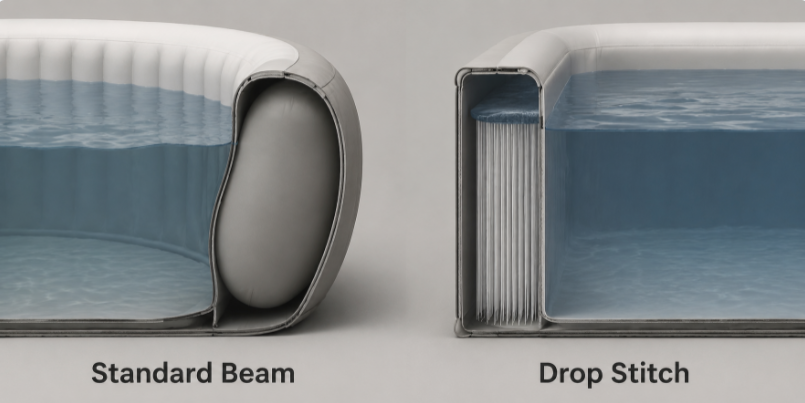
A standard inflatable hot tub is built like a pool float. Sealed air chambers shaped into round tubes rely on the curve of the tube itself to resist outward pressure. At low pressure that works fine. Fill the shell with a few hundred gallons of water and the walls start giving slightly, bowing under the weight. That flex is the ceiling on how tall the walls can go before the structure loses shape.
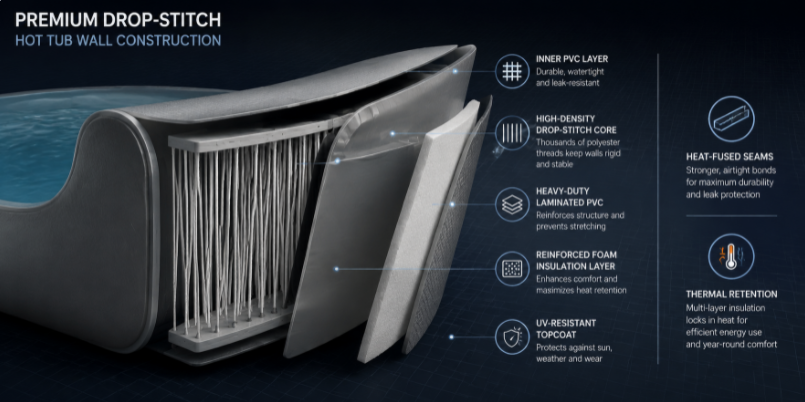
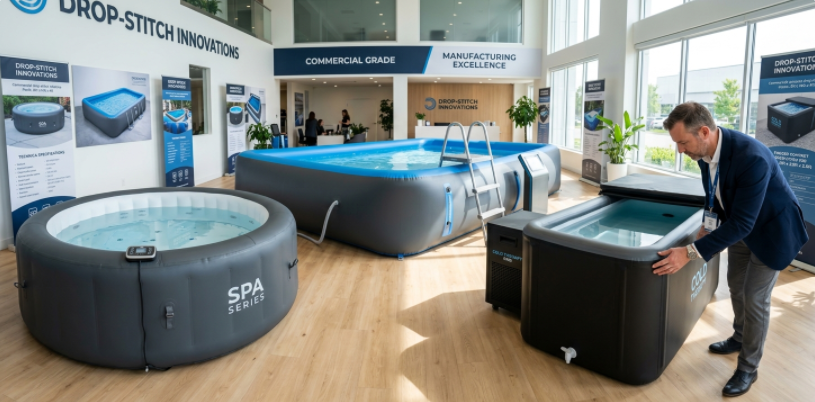
Drop stitch replaces the tube with two flat layers of PVC-coated fabric connected by thousands of tightly packed polyester threads running perpendicular between them. Inflate it and every thread snaps taut simultaneously, locking the two fabric faces into a rigid flat panel. No curve. No bow. The same construction method used in rigid inflatable stand-up paddleboards, for the same reason: a tube bends; a stitched panel doesn't.
Standard PVC inflatables hold shape at around 1 to 2 PSI. Drop stitch panels are built to take far more. Genuine drop stitch construction tolerates roughly ten times the pressure of a layered PVC shell, and that is what keeps the walls flat under a full water load rather than curving inward under pressure or outward under weight.
For a buyer who cares about multi-season durability and a product that looks good in its third year, yes. For a buyer whose customer is replacing it in twelve months anyway, the premium is wasted.
Building a drop stitch shell requires hand-sewing the internal thread matrix between the fabric layers, then heat-fusing the outer panels together. It is slower than standard PVC tube welding and requires more skilled labor. That labor cost does not disappear at higher volumes. It is still there at fifty units. Still there at two hundred.
Which is also why a drop stitch listing priced at the same level as standard PVC should raise a flag rather than register as a deal. Lower thread count, thinner outer fabric, partial drop stitch reinforcement only on the visible walls, these are the places manufacturers cut to make the number work. The buyer usually finds out in year two.
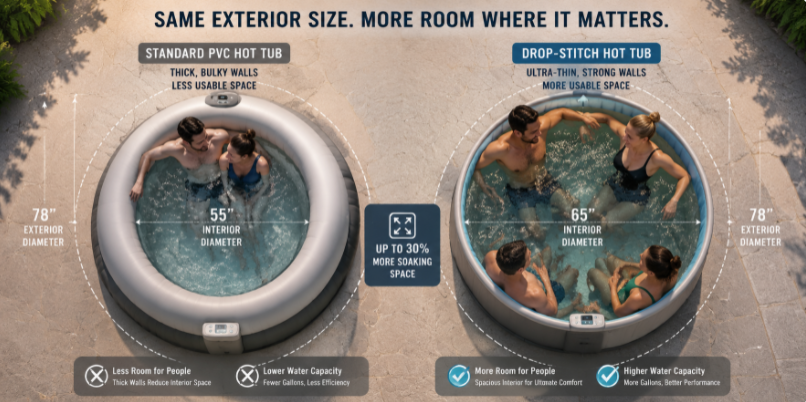
A shell that holds its shape under water load, resists puncture and abrasion better than smooth PVC at comparable thickness, and delivers more usable internal volume for the same exterior footprint, because flat walls do not need to bow outward to stay up. The thread density is also what extends service life over a standard inflated chamber, which is most relevant for units going into rental fleets or commercial accounts with heavy weekly use.
One thing rarely mentioned in product listings: heating cost. Drop stitch spas commonly pair the rigid shell with foam-insulated walls and a higher-efficiency heater design, which means they maintain water temperature using less electricity than a comparable standard inflatable. Over a five-year lifespan that is a real operating cost difference for the buyer who is running this unit year-round rather than three months in the summer.
Most drop stitch spas inflate, fill, and reach temperature in under 30 minutes. Same as standard. The portability advantage that makes inflatable worth buying in the first place does not disappear with drop stitch construction. It just comes with a shell that is still holding its shape when the box comes out for the third season.
Standard PVC inflatables under daily use typically run one to three seasons before showing meaningful wear. Drop stitch, maintained properly, routinely reaches five to ten years. That is not a modest improvement. It is a different category of product carrying the same category name.
Round portable spa MOQs sit at five to ten units from most manufacturers, with bulk pricing starting around fifty. That structure holds across both construction types. Per-unit cost is higher for drop stitch at every order tier.
Because flat walls under pressure do not bow outward, a drop stitch tub at a given exterior diameter holds more water than a standard PVC unit of the same size. On a tight showroom floor, or a customer's compact patio, that difference can close the sale faster than a spec comparison does.
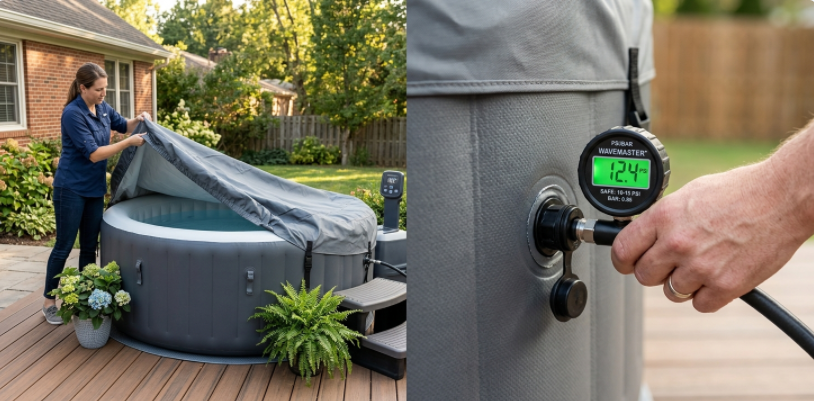
Five to ten years with proper maintenance. One to three seasons without it, which is roughly the same lifespan as a standard PVC unit at the same level of neglect.
What actually ends a drop stitch shell early: UV exposure without a cover, running it under-inflated so the panels flex instead of staying rigid, over-inflating past the rated PSI, leaving water in the shell through a hard freeze. Ask any supplier for the rated PSI range and what storage guidance they include with the product. That tells you more about realistic lifespan than the number printed on the spec sheet.
Before promising customers five-to-ten years: warranties on portable spa shells typically cover about six months, with the heater running slightly longer. The lifespan is a maintenance outcome, not a warranty guarantee. Set that expectation with customers before the sale and the return conversation becomes much simpler if something does go wrong.
Around 70% of global wholesale portable spa production is concentrated in manufacturing clusters in Guangdong, Anhui, and Jiangxi. Lead times and freight costs shift meaningfully depending on which province the factory is actually in versus where the trading company is registered. Get the factory address, not the sales office address, before you build a lead time into a client commitment.
Some suppliers use "drop stitch" to describe a product with reinforcement only on the top panel or the visible exterior wall. Get the rated PSI range in writing. Ask specifically how the seams are constructed: hand-sewn and heat-fused is correct; adhesive bonding alone is not. Request an independent factory audit report or unedited production footage. CE marking and ISO 9001 are the floor now, not a differentiator. Most established manufacturers carry both, so treating them as evidence of quality is not enough.
AFTERSEA's guide on red flags when sourcing a drop stitch inflatable pool covers the same supplier vetting questions. The material is identical and so are the shortcuts.
AFTERSEA does not manufacture finished hot tub units. We build the same DWF drop stitch construction applied to our above-ground drop stitch swimming pool line and our DWF inflatable ice bath tub, which uses the same rigid-panel build for cold therapy recovery. If you are sourcing drop stitch technology across product categories, our technical guide to drop stitch construction and our drop stitch vs. PVC durability comparison go deeper on the same material questions covered here.
That depends entirely on your customer base, not on which build is objectively better.
Buyers who care about multi-year lifespan, structural rigidity, and products that hold up in a commercial or rental setting should stock drop stitch. Buyers whose customers are seasonal, price-sensitive, or buying their first inflatable tub and likely to trade up or replace within a year or two are better served by a well-built standard PVC unit at a lower price and a lower MOQ commitment.
Most retailers land on stocking both at different price points rather than picking one. The split usually makes itself clear once you look at who is actually returning products and why.
If you are sourcing DWF drop stitch pools or ice bath tubs and want to talk through specs, MOQs, or customization options, reach out to the AFTERSEA team directly.


