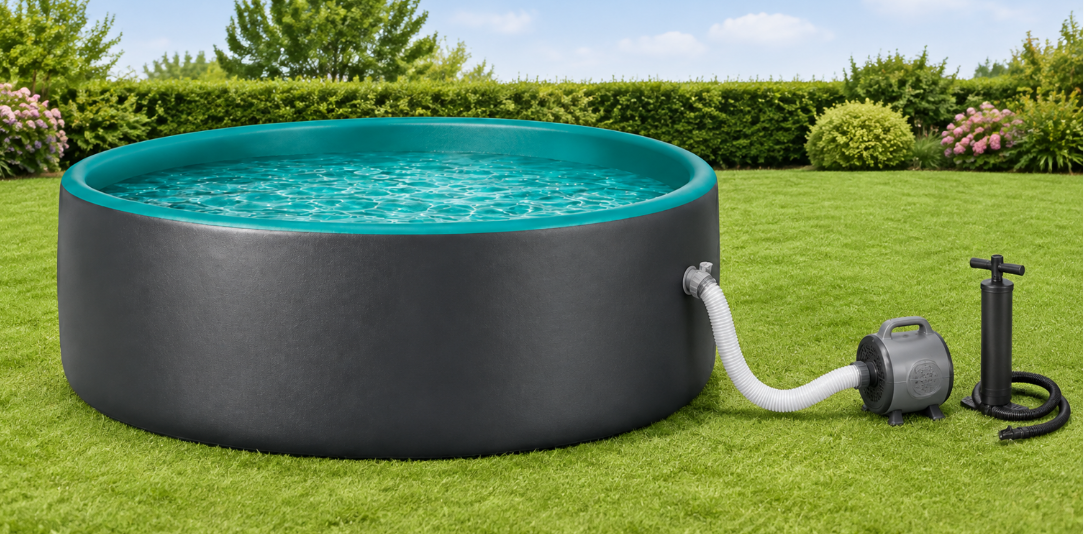
Thirty minutes is a real number for a 2 m or 3 m drop stitch pool, with two people and an electric blower. It is not a real number for a 6 m pool, and it is not a real number if you count the water.
Most setup guides skip that distinction, which is why the first afternoon with a large pool goes wrong. The pool stands up in minutes, the buyer assumes the job is nearly done, and then spends the next day watching a hose. This guide gives you the actual times for every stage, by size, so you can plan the afternoon instead of discovering it.
"Set up" means different things to a buyer, a rental operator and a pool installer. Pick the finish line before you start the clock.
| Finish line | 2 m | 3 m | 4 m | 5 m | 6 m |
|---|---|---|---|---|---|
| Ready to fill site checked, pool standing, valve closed, hose in |
17 min | 19 min | 22 min | 25 min | 29 min |
| At working pressure 10 PSI on the gauge, ready for water |
30 min | 45 min | 1 h | 1 h 25 | 1 h 50 |
| Full and swimmable water to the working depth |
+2 h | +6 h | +13 h | +22 h | +36 h |
Those numbers assume two people, a level site within a few steps of the setup spot, and a 130W blower for the volume stage. One person working alone adds roughly a third to the first two rows.
The third row is the one that surprises people. A garden hose delivers about 15 litres a minute in most homes, sometimes 20. A 6 m pool holds 32,553 litres, which is 36 hours at 15 litres a minute. You cannot compress that with better equipment. You can only start earlier.
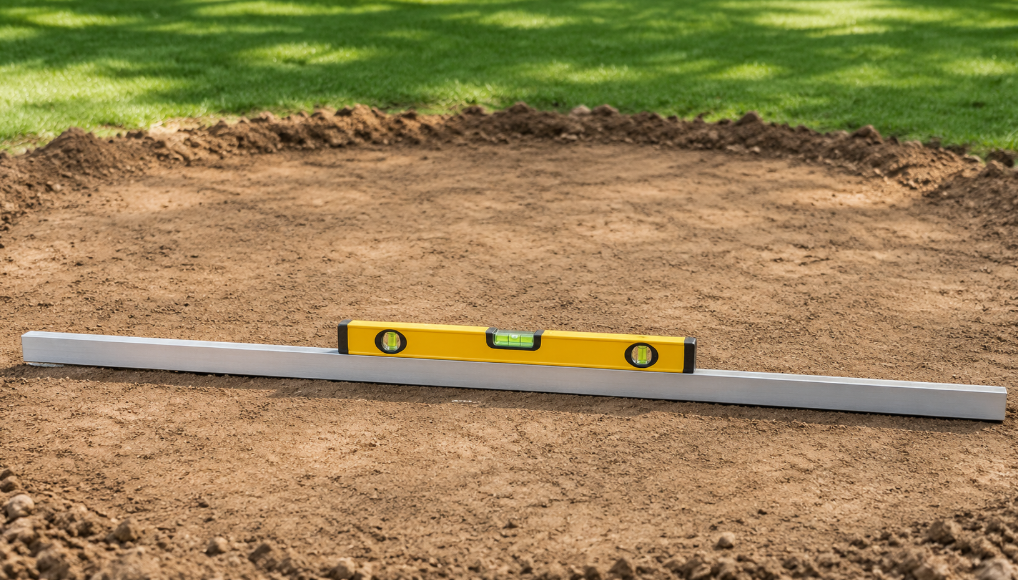
Site preparation is the part that decides whether the pool lasts. A pool set on a slope will hold water against one wall for its whole life, and that wall is where the seam fails first.
Water is heavy, and the load per square metre rises with pool size because the depth rises with it.
| Pool | Footprint | Water weight | Load on the ground |
|---|---|---|---|
| 2 m / 6.6 ft | 3.1 m² | 1.9 t | 0.60 t/m² |
| 3 m / 10 ft | 7.1 m² | 5.7 t | 0.81 t/m² |
| 4 m / 13 ft | 12.6 m² | 11.4 t | 0.91 t/m² |
| 5 m / 16 ft | 19.6 m² | 20.1 t | 1.02 t/m² |
| 6 m / 20 ft | 28.3 m² | 32.6 t | 1.15 t/m² |
Grass and soil handle 1.15 t/m² without complaint. A timber deck often does not, particularly an older one built for a barbecue and a few chairs. If you plan to put a 6 m pool on a deck, have someone confirm the joists and the footings before you fill it, because the failure mode is not a leak. It is a collapsed deck with 32 tonnes of water on it.
This is the schedule that makes the headline true. Two people, one blower, a clear site.
| Time | Task | Notes |
|---|---|---|
| 0:00 to 0:04 | Unpack and count the kit | Pool, hand pump with gauge, repair kit, bag. The 20 ft version adds a wrench. |
| 0:04 to 0:10 | Lay out, walk the site, position | Do not drag the pool across gravel. Carry it. |
| 0:10 to 0:14 | Stage one inflation | Largest nozzle, blower running. 1.8 minutes for 2 m, 3.8 for 3 m. |
| 0:14 to 0:17 | Close the valve, run the hose | Check the valve gasket is seated before you cap it. |
| 0:17 to 0:29 | Hand pump to 10 PSI | Watch the gauge. Stop at the number, not when it feels hard. |
| 0:29 to 0:30 | Open the water | Secure the hose end so it cannot whip against the wall. |
Above 3 m, the same sequence runs longer because both the air volume and the hand pumping grow faster than the pool does. A 4 m pool takes about an hour of labour, a 6 m about two hours. Plan a morning, not a lunch break.
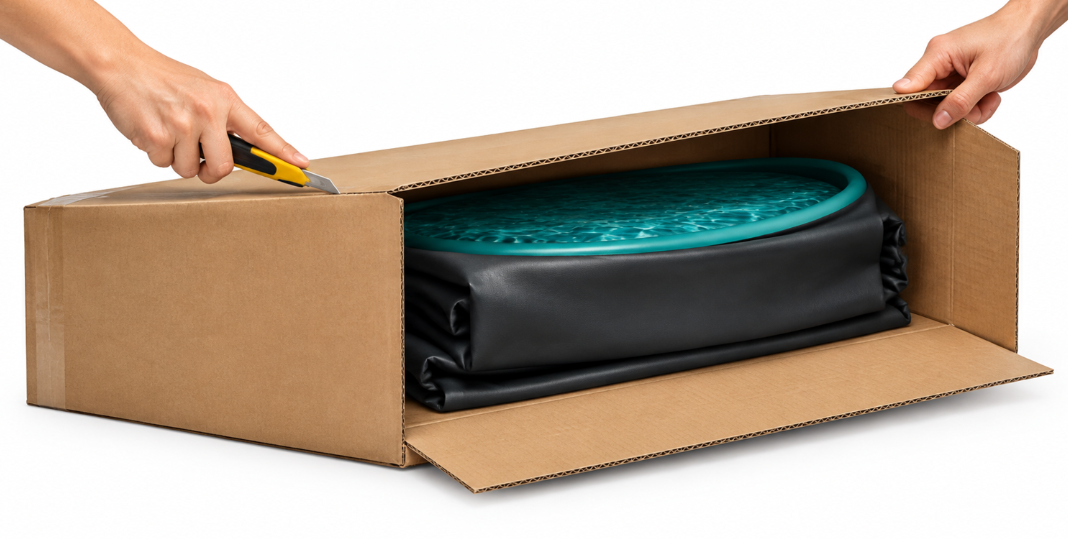
Open the carton with the blade shallow. A box cutter run along the top seam will score the folded PVC underneath, and a scored fold becomes a split within a season. Cut the tape, then pull the cardboard apart with your hands.
Count the parts before you throw anything away. The valve caps and the wrench are small, and they are the two things people lose in the first ten minutes. If the pool arrives in cold weather, lay it flat in the sun for ten minutes before you inflate. Cold PVC is stiff and the core resists unfolding.
Unfold the pool at the spot you intend to use, before you inflate it. An inflated 4 m pool is not something you slide sideways, and a 6 m one will not move at all once it has water in it.
With the pool flat, check three things. The wall sits clear of any fence or wall by at least a metre. The drain valve points somewhere the water can go. The valve you will inflate through is reachable without climbing on anything.
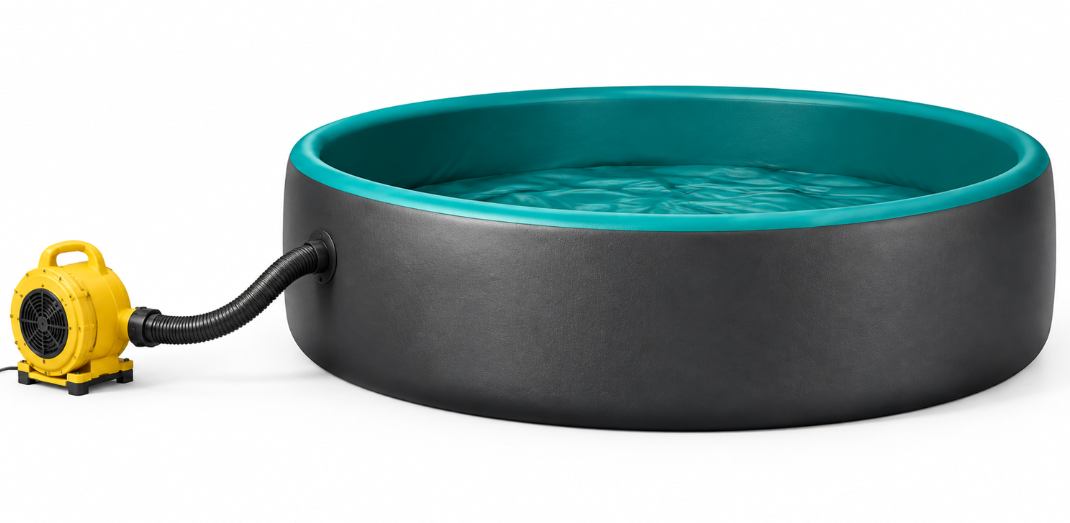
Fit the largest nozzle to the blower and open the main valve. Run until the walls stand up and the floor is flat but still soft. That is about 0.5 to 1 PSI.
| Pool | Air volume | 130W blower | Hand pump to 10 PSI |
|---|---|---|---|
| 2 m | 732 L | 1.8 min | 10 to 15 min |
| 3 m | 1,527 L | 3.8 min | 20 to 28 min |
| 4 m | 2,604 L | 6.5 min | 35 to 45 min |
| 5 m | 3,811 L | 9.5 min | 50 to 65 min |
| 6 m | 5,422 L | 13.6 min | 70 to 90 min |
The air volumes are calculated from the published outer diameter and wall height with a 10 cm core. A 15 cm core adds roughly 45% more air, which pushes every time in the right-hand column up.
Watch the clock on the blower. The 130W unit has a printed limit of ten minutes on the large nozzle, then five minutes of rest. A 6 m pool needs more than ten minutes of running, so split it into two blocks and let the motor cool in between. The same unit is listed on the pump and accessory page if you need a second one for a fleet.
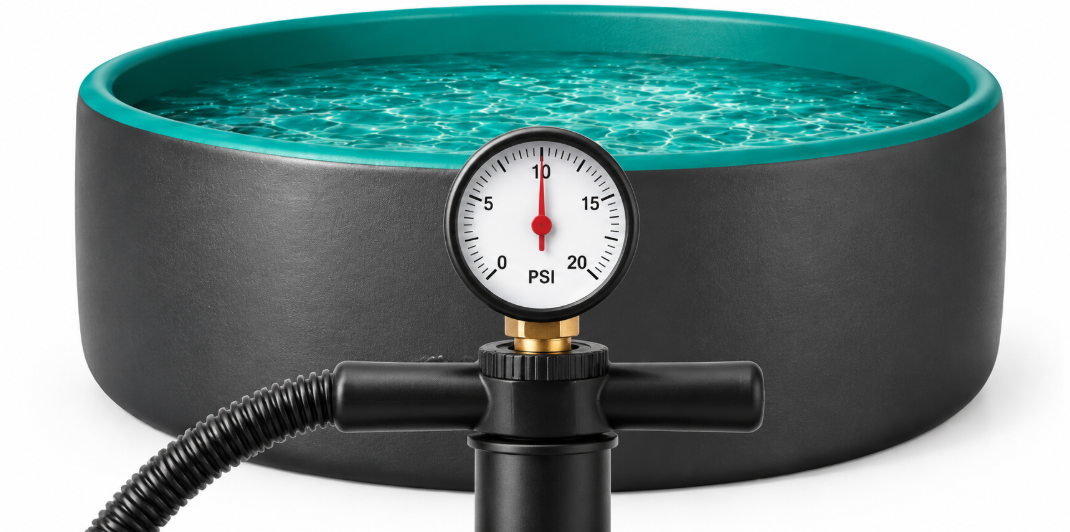
Switch to the hand pump with the gauge and take the pool to 10 PSI. Close the valve, cap it, and then leave it alone for two hours.
New material relaxes. A pool that reads 10 PSI when you finish pumping will often read 8 by late afternoon, and that is not a leak. The drop stitch layer is stretching into its final shape. Top it up once after the wait, and check again the next morning. If the reading holds overnight, the pool is sound.
If the pressure keeps falling after the first day, the problem is usually a valve rather than a wall. The leak finding and patching guide covers the pressure decay test and the valve fix that solves most cases before you touch a patch.
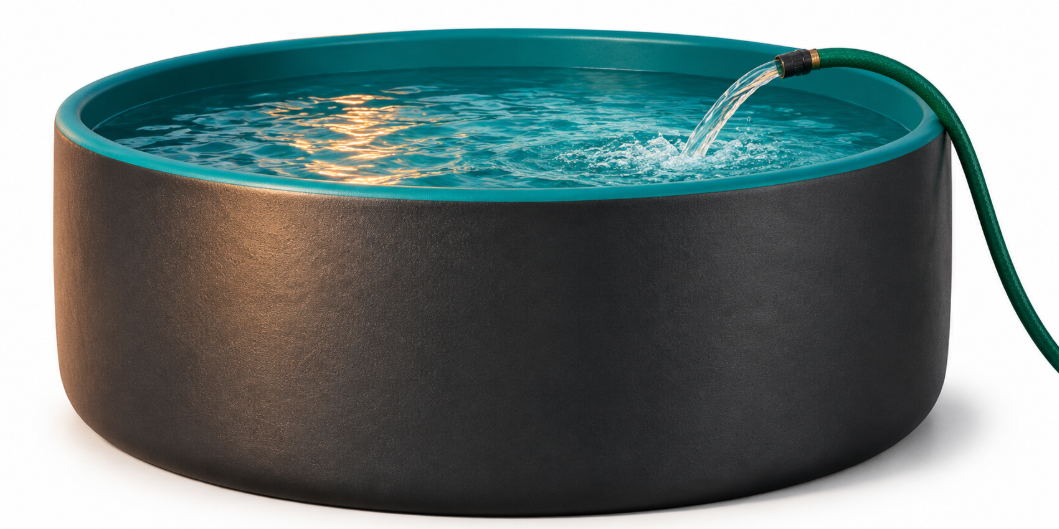
Start the water only after the pool is at pressure. Water load on a soft wall pushes the base seam outward while the core is still loose, and that is how a pool ends up with a bulge it never loses.
| Pool | Capacity | At 15 L/min | At 20 L/min |
|---|---|---|---|
| 2 m | 1,893 L | 2 h 06 | 1 h 35 |
| 3 m | 5,678 L | 6 h 19 | 4 h 44 |
| 4 m | 11,356 L | 12 h 37 | 9 h 28 |
| 5 m | 20,063 L | 22 h 18 | 16 h 43 |
| 6 m | 32,553 L | 36 h 10 | 27 h 08 |
Three things make a long fill go better.
Secure the hose end. Put it through the inflation valve if the bore allows, or tie it over the wall with the end inside the pool. A hose end that slips out will whip across the wall and can scuff or split the material in seconds.
Do not walk away for a day. A 36-hour fill left unattended will overflow at some point, and the overflow runs past the base of the pool and softens the ground under it. Check every hour or set a timer you will actually hear.
Treat the water as it fills. Thirty-six hours of untreated water in summer is enough for algae to get a start before the pool is even usable. Add a partial chlorine dose when the pool is about half full, then complete the dose at the end and run the filter from the point where it can prime. The water care guide gives the dose per size.
Fill to roughly 75 to 80% of the wall height. Below that a hang-on filter intake pulls air. Above it, every centimetre adds load to the wall seam and the first person who jumps in sends water over the edge.
| Mistake | What it costs |
|---|---|
| Setting up on a visible slope | One wall carries the load for the pool's life. The base seam fails first, and usually in the second season. |
| Inflating before clearing the ground | A stone trapped under the wall seam becomes a leak you cannot patch from outside. |
| Filling before the pool is at pressure | The base seam stretches under water load while the core is slack. The bulge stays. |
| Inflating to 10 PSI in hot sun | Pressure climbs to 12 or 13 PSI by mid-afternoon. You are loading the seam for no benefit. |
| No plan for the drain | 32,553 litres on a lawn, or through a neighbour's fence, at the end of the season. |
| Leaving the hose running overnight | Overflow softens the ground under the pool. A pool that was level on Saturday is not on Sunday. |
| Cutting the carton with a deep blade | A scored fold in the PVC splits within a season, usually at the base where it is hardest to repair. |
| Setting up on an unchecked deck | The deck fails, not the pool. This is the only mistake on the list that can hurt someone. |
Below about 10°C the PVC stiffens and the drop stitch core resists unfolding. Inflate to 5 PSI, leave it for half an hour, then continue to working pressure. Forcing a cold pool to 10 PSI in one run puts a crease in the wall that stays visible.
Above about 30°C the opposite applies. Inflate in the morning or the evening, set the pressure at the low end of the range, and expect the gauge to read higher at two in the afternoon. Check it again after the sun moves off the pool.
If you are setting up for a specific date, work backwards. A 6 m pool needs 36 hours of hose time plus 2 hours of labour plus a two-hour settle. Start on Thursday evening for a Saturday party, not on Saturday morning.
The 30-minute claim sells pools. It also creates complaints when the buyer measures a different finish line, so the wording on the carton matters.
For fleet economics and the between-jobs routine, the pool rental equipment guide covers the numbers. For end-of-season teardown, the winter storage procedure picks up where this one stops.
If you are buying pools for resale and want the setup sheet printed in your market's language, or a carton that states setup time accurately for each size, raise it in the quote. The DWF pool range and the 6.6 to 20 ft series cover 2 m to 6 m, and the size guide helps your customer pick before they order.
A 2 m pool reaches working pressure in about 30 minutes with two people. A 3 m takes about 45 minutes, a 4 m about an hour, and a 6 m close to two hours. Add the water separately: 2 hours for a 2 m pool, 36 hours for a 6 m at 15 litres a minute.
Only if someone confirms the structure carries the load. A 6 m pool puts 1.15 tonnes on every square metre, which is 32 tonnes in total. Most residential decks are not built for that, and the failure is structural rather than a leak.
Yes. Grass and soil carry the load without trouble. Trim it short first, remove stones and twigs, and put a ground sheet under the pool to stop moisture and soil staining the base. Avoid freshly treated lawn for a week.
It is worth the cost. A sheet protects the base from stones and stops the dark marks that soil and tannin leave on PVC. A piece of geotextile or a heavy tarp cut slightly larger than the footprint is enough.
If it is the first day, it is probably the material relaxing. Top it up and check again in the morning. If it keeps dropping after that, test the valves with soapy water before you look for a hole in the wall.
The inflation, yes. The handling, no. The largest pool is around 91 kg in its bag, and the hand pumping stage runs 70 to 90 minutes. Plan for a second person or a high pressure pump with a gauge.


